Categories
In Case You Missed It Museum Events

McMullen Art After Dark: Fall 2025

By: Emily Barnabas ’26

The Student Ambassadors hosted their biannual student opening at the McMullen Museum of Art on September 5, 2025, debuting three feature collections: Medieval | Renaissance, A Fresh Vision, and Martin Karplus. With overflowing trays of charcuterie and platters of cannolis, students enjoyed crafts, games, live performances, film, and of course, new art!

Sexual Chocolate started a night of memorable student performances. Gathering a sizable crowd in the museum’s glass atrium, the all-male step group stunned visitors with their set and finished their performance to loud applause. Acapella performances by The Dynamics, The Common Tones, and The Acoustics followed, creating a joyful and energetic atmosphere. BC’s Music Guild wrapped up the night, showcasing a variety of talented individual performers and bands.

The Daley Family galleries on the second floor, the temporary home to Italian Medieval and Renaissance art and Belgian landscape paintings from the Tervuren artist colony, were transformed into crafting spaces where students crowded around tables to make framed mosaics and felt figures. With ceramic pieces and small gemstones spilled onto tables, students spent time laying their designs, applying grout, and sealing their creations. 

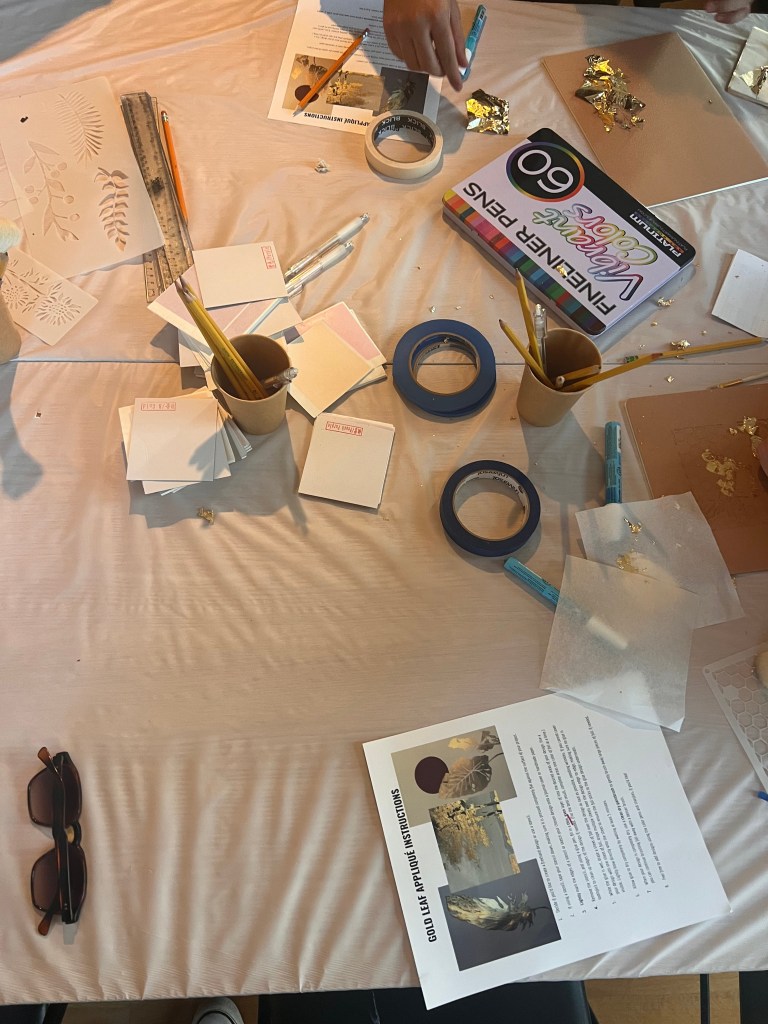
In the 3rd floor gallery, next to the collection of post-war photographs by Nobel Prize-winning chemist Martin Karplus, was a space dedicated to making gold-leaf motifs. A nod to the ornate use of gold embellishment in works of the Medieval | Renaissance, student ambassadors showed visitors how to prime, adhere, and apply gold leafing to their stationary item of choice.  

A beloved tradition of Art After Dark, indoor and outdoor games remained popular throughout the night. Inspired by the featured collections, participants tried their hand at Italian board games like Scope, Briscola, and Tressette, as well as Renaissance classics such as Tuscany, Citadels, and Trade and Triumph. The fun continued outdoors where visitors enjoyed the summer evening with lawn games like Axe Throwing, Giant Yahtzee, Giant Connect Four, Giant Jenga, and Lawn Bowling. Offering a break from all the entertainment, Moby Dick and other movies played continuously in the 1st floor galleries to offer students a place to enjoy food, drinks, and good company.

However, one of the most popular activities of the night was the Art After Dark Scavenger Hunt, affording winners the opportunity to pick their choice of a McMullen t-shirt or hoodie. Visitors dashed between floors, through galleries, and raced to find an ambassador to claim their prize. A favored tradition of Art After Dark, the scavenger hunt offers visitors a way to engage and explore the museum in a more meaningful way–-rewarding lucky winners with signature McMullen merch.

The McMullen Museum’s exhibitions showcase a diverse spectrum of artistic vision across centuries. Medieval | Renaissance presents nineteen rarely seen works from Florence’s Frascione Collection, tracing the evolution of Italian painting from the late thirteenth to early sixteenth centuries and exploring the transition between medieval and Renaissance art. A Fresh Vision highlights a transformative gift of thirty-six nineteenth-century Belgian landscapes from the School of Tervuren, celebrating artists who turned to nature for truth and renewal amid modernity’s rise. Complementing these historical collections, Martin Karplus: Photographic Journeys features fifty-five vibrant digital prints from the 1950s and 1960s, revealing the Nobel laureate’s humanistic lens on a changing postwar world. See all of these exhibits, as well as our featured first floor permanent collection, until December 7, 2025.
Categories
Exhibition Spotlight

Reflecting on the States of Becoming Exhibit

By: Chase Gibson ’26

States of Becoming is an exhibition curated by Fitsum Shebeshe that displays contemporary art in the African diaspora, and the exhibition brings together seventeen African artists from twelve countries who relocated and resettled in the United States. Their art shows their struggle to come to grasps with the conflict of their African heritage and the dominant American cultural paradigms. The artists share their experiences with culture, identity, belonging, and discrimination through various methodologies. 

There are three groups of artists. First, there are artists whose relocation prompted them to make aesthetic transformations, creating what are called hybrid aesthetics. Second, there are artists who share the stories from their origin country to their communities in the United States. Third, there are artists who use their art to draw connections between the African Diaspora and the United States. States of Becoming hosts the work of artists who find themselves and a sense of belonging through their work as they construct hybrid aesthetics and cultures.

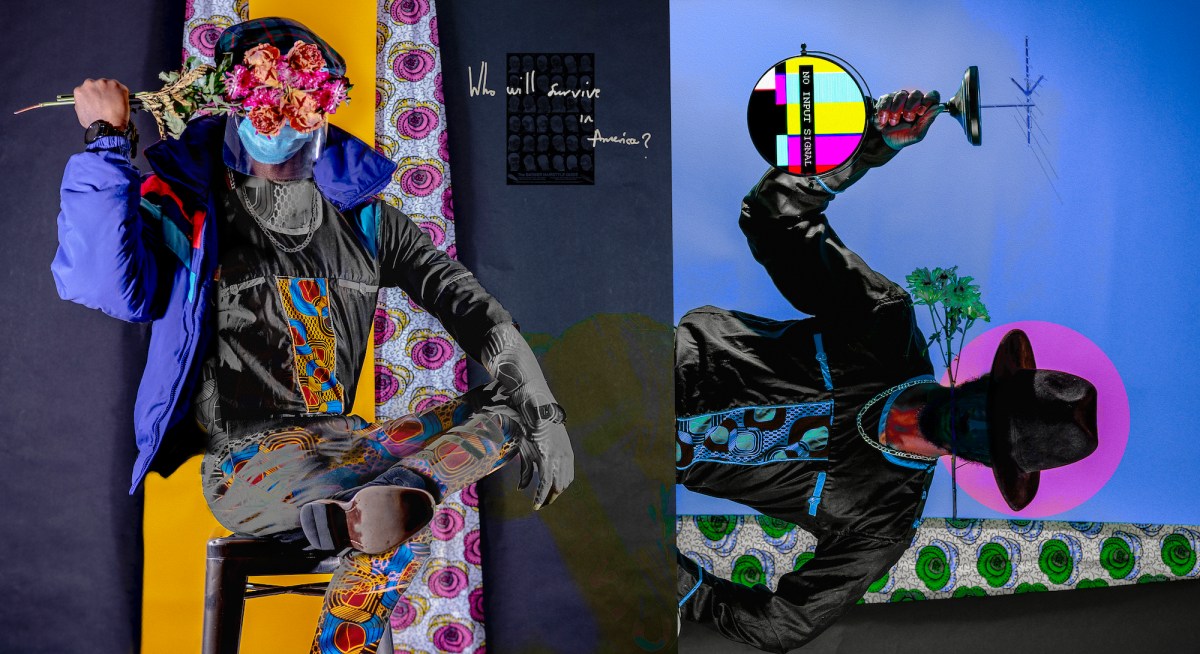
Chukwudumebi Gabriel Amadi-Emina is a Nigerian American photographic and video artist whose work Bombu Afomo / MineSweeper (2020) explores what it means to be African American from the perspective of someone who assimilates into American culture as a black African newcomer. Amadi-Emina depicts himself as a soldier in the war on racism, implementing elements of his Nigerian identity with his new African American identity. Amadi-Emina constructs a new version of himself, creating an identity altered by his relocation, a hybrid aesthetic.

Yvonne Osei is an artist from Ghana that addresses racial categorization through her work Between the Voids (2012) which explores the effects of the black and white dichotomy on identity in the United States. Osei comes from the Ashanti Kingdom in Ghana, where her blackness is a thing of pride. However, in her new home, her blackness is reduced to something to be categorized which fails to capture the spectrum of racial identity. Osei’s work rejects attempts to draw a line between white and black. Instead, Osei challenges whether the line matters at all.

Kern Samuel is a Trinidadian artist living in New Haven who attempts to find meaning in an ever changing context. Samuel used drawing, painting, and sewing along with spices and dyes to create An Island (2021) depicts Samuel’s struggle with self-representation without creating an abstraction of self. Samuel’s work uses the language of materials to evoke his childhood in Trinidad as a reflection on his cultural identity. The artist explores the significance that his Trinidadian upbringing has on his selfhood. 

Hannah Arendt and Kwame Anthony Appiah are two substantial contributors to the conversation on identity and belonging in a modern, globalized context. Arendt, a Jewish refugee herself of World War II, wrote on the importance of identity in a world that only recognizes the value of one’s opinion if they belong as citizens to a recognized democratic government. To Arendt, identity is crucial to political participation, because citizenship gives value to an opinion. She emphasizes plurality of identity and avoiding rigid or singular identities. Osei and Arendt share in their attitude towards identity as they both embrace spectrum thinking and recognize the nuances to understanding selfhood. When Osei challenges ideas of absolute racial identity like full blackness or full whiteness, she challenges racial categorization as a whole which embraces Arendt’s idea that pluralism does not look to reduce identities to simpler, less true versions of themselves.

Appiah wrote on culture as not “a box to be checked on the questionnaire of humanity; it’s a process you join, in living a life with others.” He recognizes the ever-changing nature of culture and identity. Culture is no more permanent than any one individual which means both are bound to change, develop, and evolve. As Kern Samuel depicts in his art, a sense of meaning can be difficult to find when the political, economic, geographic, or any other context is constantly changing around an individual. Appiah calls on his readers to “see ourselves as others see us.” In this way, there is a harmony between both social and private identities, and the self is continuous across both contexts. Amadi-Emina depicts in his artwork the complicated relationship, the disharmony, between social and private identities which creates a new aesthetic in an effort to culturally adapt. This new aesthetic is not made willingly but rather forced by a life contextualized by institutionalized racism.

States of Becoming will be on display in the McMullen Museum of Art at Boston College from September 9 to December 8, 2024. The exhibition features the work of fourteen other artists, all with something to say on themes of identity, belonging, culture, and oppression. They use painting, photography, sculpture, installation, and video to reimagine identity and bring light to their personal histories coping with selfhood in the United States as part of the African diaspora.

Categories
Uncategorized

A Letter From the Editor

Welcome back to the McMullen Museum and The Terrace! As this year’s chair of the Publications Committee, it is my honor and privilege to extend my welcome to all visitors and readers, returning and new. As we descend into the fall, I wish that all members of the community include the McMullen Museum in their seasonal plans.

Through December, the museum will display Gateway to Himalayan Art, a special exhibition courtesy of New York’s Rubin Museum. This exhibit explores the vast array of Himalayan art and artifacts and examines the various connections to the region’s cultures, histories, and religions. Primarily featuring Buddhist symbols and traditions, the pieces work to educate and demonstrate what Buddhism means within the Himalayan region.

Additionally, the Carolyn A. and Peter S. Lynch Collection will permanently be on display beginning in October. This impactful gift of 19th- and 20th-century paintings will furnish the University Conference Center and be open to the public. The collection features 27 paintings and drawings by 20 revered artists, which will transform and elevate what the museum has to offer.

As for The Terrace, our upcoming year looks to emphasize and develop the strong scaffolds from previous years. Our spotlight on local artists, ‘Artists Across Comm Ave,’ will continue to appreciate and accentuate the work of artists in our community. Additionally, we aspire to stay focused on our mission of social justice by continuing to examine ‘Problematic Visual Culture’ in terms of the museum and beyond. Finally, we hope that our writing and work continue to inspire, educate, and reach our readers in new and exciting ways.

As always, we are looking to collaborate throughout the greater Boston College community, especially in terms of our current exhibit and the new Lynch Collection. If any and all groups are interested, please reach out to Rachel Chamberlain with further questions and proposals.

Again, I am beyond grateful and excited to lead the Publications Committee this year and welcome everyone back to The Terrace! I look forward to the fantastic work that my fellow Student Ambassadors will do. For a full calendar of events, please visit this page. As always, the museum is free and open to the public seven days a week.

Thank you for being a part of The Terrace and for being an amazing and crucial part of the McMullen community!

Sincerely,

Liam Conner, ’25

Liam Conner, the Chair of the Publications Committee.