By: Chase Gibson ’26
States of Becoming is an exhibition curated by Fitsum Shebeshe that displays contemporary art in the African diaspora, and the exhibition brings together seventeen African artists from twelve countries who relocated and resettled in the United States. Their art shows their struggle to come to grasps with the conflict of their African heritage and the dominant American cultural paradigms. The artists share their experiences with culture, identity, belonging, and discrimination through various methodologies.
There are three groups of artists. First, there are artists whose relocation prompted them to make aesthetic transformations, creating what are called hybrid aesthetics. Second, there are artists who share the stories from their origin country to their communities in the United States. Third, there are artists who use their art to draw connections between the African Diaspora and the United States. States of Becoming hosts the work of artists who find themselves and a sense of belonging through their work as they construct hybrid aesthetics and cultures.
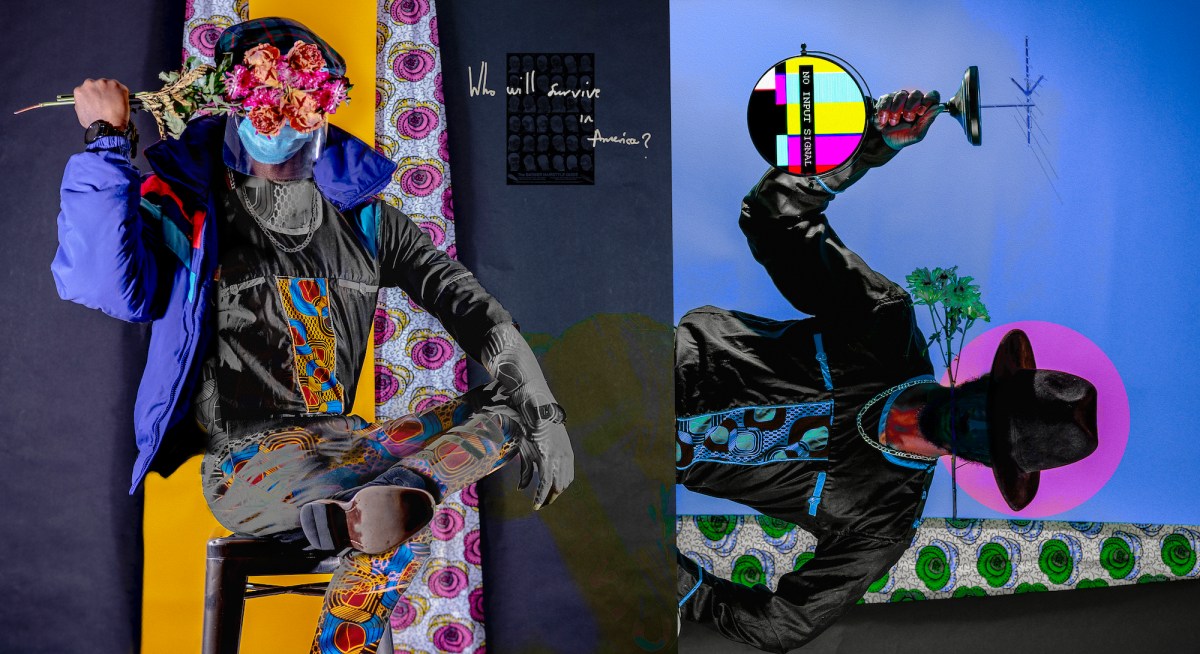
Chukwudumebi Gabriel Amadi-Emina is a Nigerian American photographic and video artist whose work Bombu Afomo / MineSweeper (2020) explores what it means to be African American from the perspective of someone who assimilates into American culture as a black African newcomer. Amadi-Emina depicts himself as a soldier in the war on racism, implementing elements of his Nigerian identity with his new African American identity. Amadi-Emina constructs a new version of himself, creating an identity altered by his relocation, a hybrid aesthetic.
Yvonne Osei is an artist from Ghana that addresses racial categorization through her work Between the Voids (2012) which explores the effects of the black and white dichotomy on identity in the United States. Osei comes from the Ashanti Kingdom in Ghana, where her blackness is a thing of pride. However, in her new home, her blackness is reduced to something to be categorized which fails to capture the spectrum of racial identity. Osei’s work rejects attempts to draw a line between white and black. Instead, Osei challenges whether the line matters at all.
Kern Samuel is a Trinidadian artist living in New Haven who attempts to find meaning in an ever changing context. Samuel used drawing, painting, and sewing along with spices and dyes to create An Island (2021) depicts Samuel’s struggle with self-representation without creating an abstraction of self. Samuel’s work uses the language of materials to evoke his childhood in Trinidad as a reflection on his cultural identity. The artist explores the significance that his Trinidadian upbringing has on his selfhood.
Hannah Arendt and Kwame Anthony Appiah are two substantial contributors to the conversation on identity and belonging in a modern, globalized context. Arendt, a Jewish refugee herself of World War II, wrote on the importance of identity in a world that only recognizes the value of one’s opinion if they belong as citizens to a recognized democratic government. To Arendt, identity is crucial to political participation, because citizenship gives value to an opinion. She emphasizes plurality of identity and avoiding rigid or singular identities. Osei and Arendt share in their attitude towards identity as they both embrace spectrum thinking and recognize the nuances to understanding selfhood. When Osei challenges ideas of absolute racial identity like full blackness or full whiteness, she challenges racial categorization as a whole which embraces Arendt’s idea that pluralism does not look to reduce identities to simpler, less true versions of themselves.
Appiah wrote on culture as not “a box to be checked on the questionnaire of humanity; it’s a process you join, in living a life with others.” He recognizes the ever-changing nature of culture and identity. Culture is no more permanent than any one individual which means both are bound to change, develop, and evolve. As Kern Samuel depicts in his art, a sense of meaning can be difficult to find when the political, economic, geographic, or any other context is constantly changing around an individual. Appiah calls on his readers to “see ourselves as others see us.” In this way, there is a harmony between both social and private identities, and the self is continuous across both contexts. Amadi-Emina depicts in his artwork the complicated relationship, the disharmony, between social and private identities which creates a new aesthetic in an effort to culturally adapt. This new aesthetic is not made willingly but rather forced by a life contextualized by institutionalized racism.
States of Becoming will be on display in the McMullen Museum of Art at Boston College from September 9 to December 8, 2024. The exhibition features the work of fourteen other artists, all with something to say on themes of identity, belonging, culture, and oppression. They use painting, photography, sculpture, installation, and video to reimagine identity and bring light to their personal histories coping with selfhood in the United States as part of the African diaspora.