Categories
Into the Collection

A McMullen Winterlude

By: Emily Barnabas ’26

Winterlude, let’s go down to the chapel

Then come back and cook up a meal

Well, come out when the skating rink glistens

By the sun, near the old crossroad sign

The snow is so cold, but our love can be bold

Winterlude, this dude thinks you’re fine

Winterlude by Bob Dylan may be one of the best snow day songs. By capturing the essence of a slower, simpler life, Dylan’s lyrics evoke the quiet magic and new possibility that arrives with snowfall. With over 20 inches of snow falling in late January, Boston College students enjoyed a winterlude of their own. Whether they were socializing at the “Snarty” in the Mods or curling up with hot chocolate on the couch, the storm provided a welcome reprieve from the frantic start of the semester. 

Moments of winterlude have been documented in art for ages. Whether it be written recollections or visual representations, there is something special about the way that snowfall makes us pause and reflect. The Permanent Collection of the McMullen Museum of Art features several notable snow scenes, those of which capture the transformative nature of winter. In celebration of this season, this feature will highlight selected works from the Permanent Collection, discussing how artists across periods and styles have interpreted the spirit of this time of year.
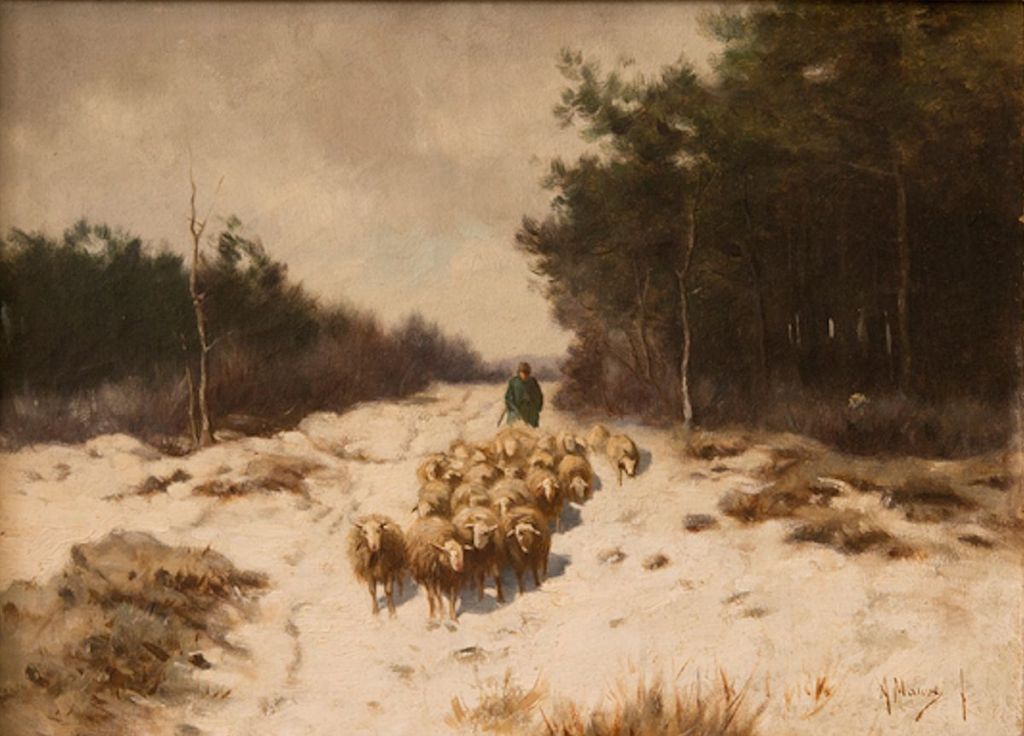
Anthonij (Anton) Mauve (1838–1888)
Snow Scene with Sheep, c. 1882–88
Oil on canvas, 9.3 x 12.5 in.
McMullen Museum of Art, Boston College, 1988.91

Snow Scene with Sheep depicts a tranquil scene of a clustered flock of sheep with a shepherd trailing nearby in the background. Hands stuffed deep into coat pockets and bundled in layers of dark green, the shepherd’s dedication to tending their flock through the winter chill can be interpreted as a metaphor for social and spiritual care (Howe). Mauve’s use of tonal gradations and soft brush strokes create the illusion of depth, signaling the distance that the flock has traveled. When looking at this work, one may imagine the solitude of this journey and sense the resilience needed to persist through such a landscape. In this suspended moment, the subjects’ movement feels slow and deliberate, each step through the snow symbolizing steadfast care in the midst of nature’s austerity. 
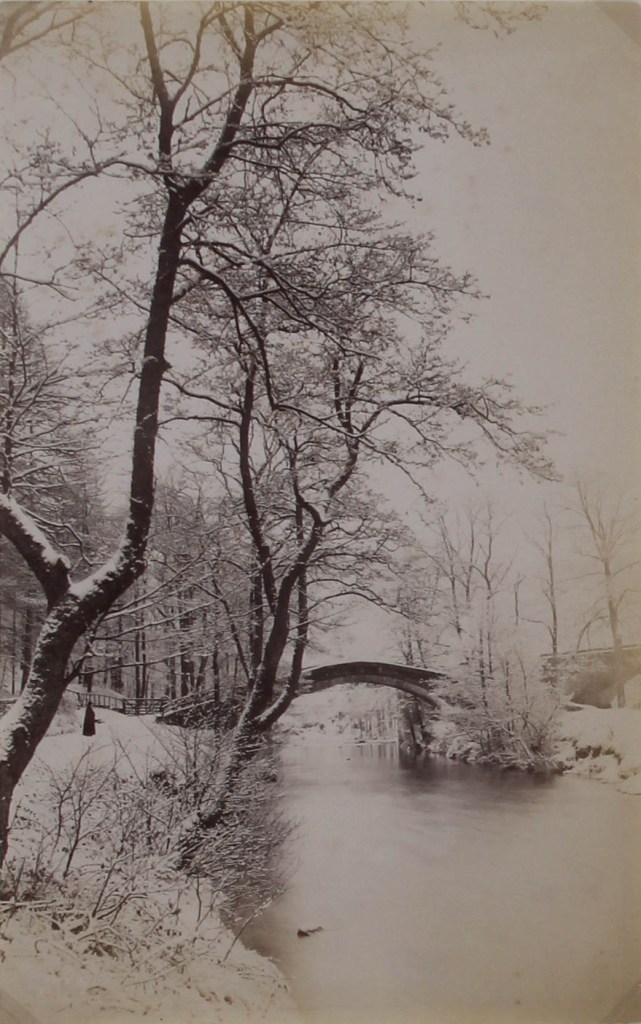
Frank-Meadow Sutcliffe (1853–1941)
Beggars Bridge, Yorkshire in Snow (near Whitby), c. 1900
Albumen print, 8 x 5 in.
McMullen Museum of Art, Boston College, Gift of David L. Mahoney and Winn Ellis, December 2002, 2002.51

Viewing Sutcliffe’s Beggars Bridge is like listening to Fleetwood Mac’s Landslide, exuding feelings of longing, seclusion, and tranquility.

Then I saw my reflection in the snow covered hills

Til the landslide brought me down

An Albumen print, a method of producing photographic print using a mix of egg whites and salt, this intricate snowscape is brought to life in the small fibers of silver nitrate that bind to the paper. Taking a closer look, the variety of lines—visible in the delicate tree branches and gentle curve of Beggars Bridge—guides the viewer’s eye across the composition with soft intention. Placing emphasis on the subtle impressions left in the snow, this graceful scene carries a deeper emotional weight that is reflective of a literal and symbolic passage through the isolation of winter.

Arnie Jarmak (1949–)
Snow Mask, Blizzard of ’78, 1978, 17 x 10.125 in.
McMullen Museum of Art, Boston College, Gift of the Artist, 2021.71

Following a snowstorm in February of 1978, Jarmak took his camera on a stroll to capture the impact of the historic snowstorm which struck the area. Photographing along the Mystic River (Tobin) Bridge, the local cantilever truss bridge which connects Boston and Chelsea, Jarmak encountered an instance of pure joy and winterlude. What appears as a photograph of a masked, but grinning, child in the snow represents so much more: “a recognition of [their] humanity made visible in the final print” (Andersen & Larsen). Jarmak’s photograph tells an additional narrative of Chelsea’s community, one rich in internal pride and resilience. Through the photographic medium, Jarmak’s striking portrait reminds audiences that moments of joy should not be overlooked during times of hardship.

Works Cited

Howe, Jeffrey. “Snow Scene with Sheep.” McMullen Museum of Art, Boston Collegehttps://mcmullenmuseum.bc.edu/anthonij-mauve-snow-scene-with-sheep/. Accessed 9 Mar. 2026

Arnie Jarmak: Photographing Chelsea in Transition, 1977–89. Edited by Ash Anderson and Diana Larsen, McMullen Museum of Art, Boston College,2022. https://bcweb.bc.edu/mcmullen/exhibitions/jarmak/Jarmak.pdf. Accessed 9 Mar. 2026.

Categories
Exhibition Spotlight

Powerful Cuban Female Artists of the Lost Generation

By Emily Barnabas ’26

Opening on January 29, 2024, Boston College’s McMullen Museum of Art will host “The Lost Generation: Women Ceramicists and the Cuban Avant-Garde,” an exhibition showcasing the artistic products of the Taller de Santiago de las Vegas. Produced amidst the Cuban Revolution (1949-59) in a ceramic workshop on the outskirts of Havana, over one hundred vases, mugs, water jugs, murals, and plates will be on display for visitors. While these objects are remarkable as beautiful pieces of artwork, their significance to the exploration of gender, psychology, social status, and cultural attainment in Cuban society is equally fascinating.1 We can track this artistic movement back to Juan Miguel Rodriguez de la Cruz, the owner of the premier Taller de Santiago de Las Vegas, and he was known for employing little-known female ceramicists. In Spanish, “taller” refers to an art studio or workshop. 

To better appreciate the importance of “The Lost Generation: Women Ceramicists and the Cuban Avant-Garde,” let us take a look at some of the women who made reverberations in two main ways: first, for the acceptance of ceramics as a Cuban fine art form and second, for the acknowledgment of women in the arts.

Artists outside the Taller de Santiago de las Vegas, November 1953: Rosita Jiménez, Aleida González, Amelia Peláez del Casal, Juan Miguel Rodríguez de la Cruz, Mirta García Buch, María Elena Jubrías Álvarez.

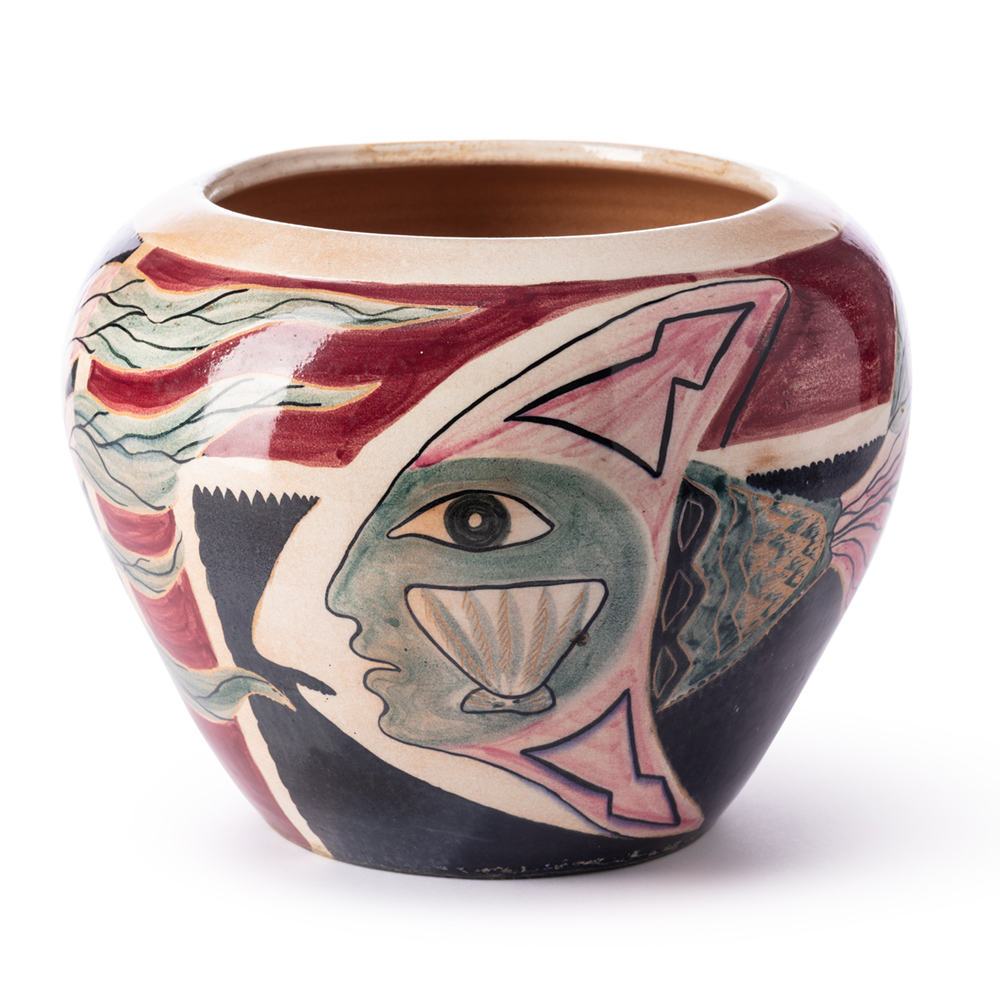
Mirta Garcia Buch (1919-96) (pictured above; second from right) pioneered artistic ceramics in Cuba. She is best known for her murals of ceramic fragments displayed at Hotel El Bosque and Hotel La Sirena in Varadero, which she completed in 1995. In the McMullen exhibition, visitors can observe Buch’s craft in the work Flower Pot with Fish-Man, a painted ceramic from 1953. Other notable achievements of Buch include her work as a technical draftsman at the National Institute of Agrarian Reform and as a technical lithography draftsman at the National Bank of Cuba.2 A selection of her works are part of a permanent exhibition at the Palace of Fine Arts of the National Institute of Culture in Havana.

Mirta Garcia Buch, Artist (1919-96) & Juan Miguel Rodriguez de la Cruz, Ceramicist (1902-90) Flower Pot with Fish-Man, painted ceramic (1953), private collection.

Amelia Pelaez (1896-1968) (pictured above; center) used cubist and European modernist styles in her ceramics. Unlike other female ceramicists in the exhibition, Pelaez had extensive art training. As a student, she moved to Paris on a grant from the Cuban government to study art solely.3  She seized this opportunity by taking Nationale Superieure des Beaux-Arts and Ecole du Louvre classes. The eleventh Salon de Tuileries featured Pelaez as a testament to her studies. After returning to Cuba, Pelaez worked in a solo exhibition at a women’s art club in Havana, known as the Lyceum; this female-centered art space helped Pelaez achieve her renowned modernist Cuban style. Beyond ceramics, Pelaez was interested in paintings, drawings, and murals. Her fervent passion for the arts led her to accomplish acclaimed murals at the Habana Hilton Hotel and Tribal de Cuentas in Havana. After she died in 1968, the Museum of Modern Art in New York City acquired many of Pelaez’s pieces. Today, we remember Pelaez as a trailblazer in Cuban art and one of the first to introduce artistic symbolism into ceramics.4 You can view Pelaez’s artistry in this spring’s (2024) exhibition by seeing the piece Ceramic tiles for Salesian Rose Perez Velasco House Mural, a series of painted ceramic tiles from 1956.

Amelia Pelaez, Artist (1896-1968) & Rene Martinez Palenzuela, Ceramicist (1956-) Ceramic tiles for Salesian Rose Perez Velasco House Mural, Painted ceramic tiles (1956/199), © Pan American Art Projects

Most of the remaining information on Elia Rosa Fernandez de Media‘s life and artistic work is from the University of Miami’s Elia Rosa F. Mendia Collection.5 The collection holds personal papers, photos, and media correspondence for research purposes. One of the more interesting materials in the collection is a booklet from the Cuban Museum of Art and Culture’s exhibit on Cuban women. As a lesser-known Cuban artist, we celebrate Mendia today for her Nordic-inspired and austere ceramics.6 In collaboration with artists like Marta Arjona and Amelia Pelaez, Mendia developed her craft by creating art in her own Taller de Vedado.

The work pictured below exemplifies the collaboration between female artists during the “golden age” of Cuban ceramics. The painted ceramic plate, Collective Plate with Fish Motifs, is a product of Rosa Jimenez, Aleida Gonzalez, Maria Elena Jubrias, Mirta Garcia Buch, and Elia Rosa Fernandez de Mendia. As represented in the piece, the camaraderie between Cuban female artists produced a period of power in Cuban art history. With their various styles blending, it is clear that they created their very own ceramic aesthetic together, and we should forever remember the legacy of Cuban female artists.

Ceramicist: Juan Miguel Rodríguez de la Cruz (1902-90) Collective Plate with Fish Motifs, painted ceramic (1954), private collection.
  1. For Cuban Modern Art, see https://moderncubanart.com/Cuban-Art-and-National-Identity accessed 12/09/23. ↩︎
  2. For Mirta García Buch: Synthesis of her life and artistic career, see https://cmlezama.blogspot.com/2020/04/mirta-garcia-buch-sintesis-de-su.html accessed 12/09/23. ↩︎
  3. For Amelia Peláez, see https://en.wikipedia.org/wiki/Amelia_Pel%C3%A1ez accessed 12/09/23. ↩︎
  4. For Amelia Pelaez (Cuban 1896-1968), see https://www.christies.com/en/lot/lot-4804057 accessed 12/09/23. ↩︎
  5. For the University of Miami’s Elia Rosa F. Mendia Collection, see https://atom.library.miami.edu/chc5189 accessed 12/09/23. ↩︎
  6. Manuel Fernández Velázquez, “Approach to the Emergence of Artistic Ceramics in Cuba,” see http://portal.amelica.org/ameli/journal/784/7843888003/7843888003.pdf accessed 12/09/23. ↩︎
Categories
Lecture Archives Uncategorized

“The BC Eagle: A Japanese Masterpiece Restored” by Diana Larsen (Lecture 11/14/2018)

On November 14, 2018, the McMullen Museum welcomed its own Diana Larsen, Assistant Director and co-curator of the spring 2019 exhibition, Eaglemania: Collecting Japanese Art in Gilded Age America, for a lecture recounting the history and recent restoration of the original BC eagle sculpture.

This lecture took place at the McMullen Museum of Art on November 14, 2018.