Categories
Art Abroad Uncategorized

The Mona Lisa Heist

By: Elona Michael ’28

Amid a quiet Sunday evening at the Louvre, on August 20, 1911, a mysterious man with a peculiar mustache gave birth to the most famous work of art in the world. Well, not literally, but one can make a strong connection to it.

Everyone knows the Mona Lisa, painted by the well-renowned Italian Renaissance painter Leonardo da Vinci, celebrated through its personal yet mysterious depiction of Mona Lisa herself and the artist’s realist techniques. It has become a world-renowned staple, always surrounded by long lines of visitors at the Louvre and endless conspiracy theories online.

Yet, there was once a time when the painting stood as one of the vast selections of Renaissance pieces in the Salon Carré.

In 1908, a young Italian man named Vincenzo Peruggia moved from his small town in northern Italy to Paris, where he found a cleaning and framing job at the Louvre. His duties mainly consisted of maintenance as well as constructing protective cases for certain valuable pieces of art, and this happened to include the box frame surrounding the Mona Lisa. 

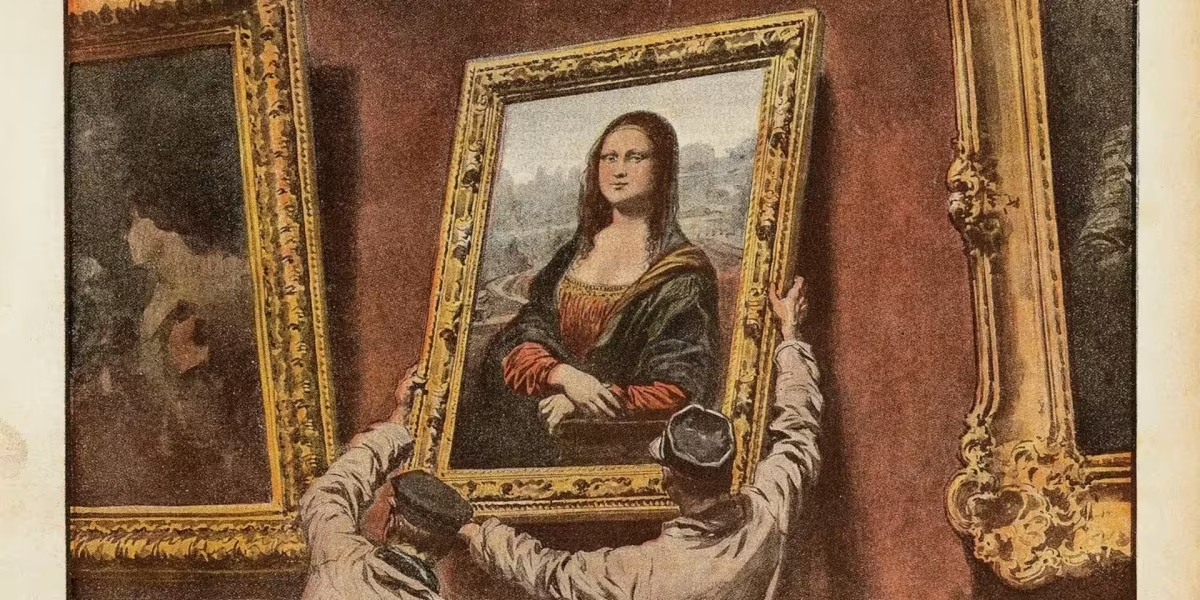
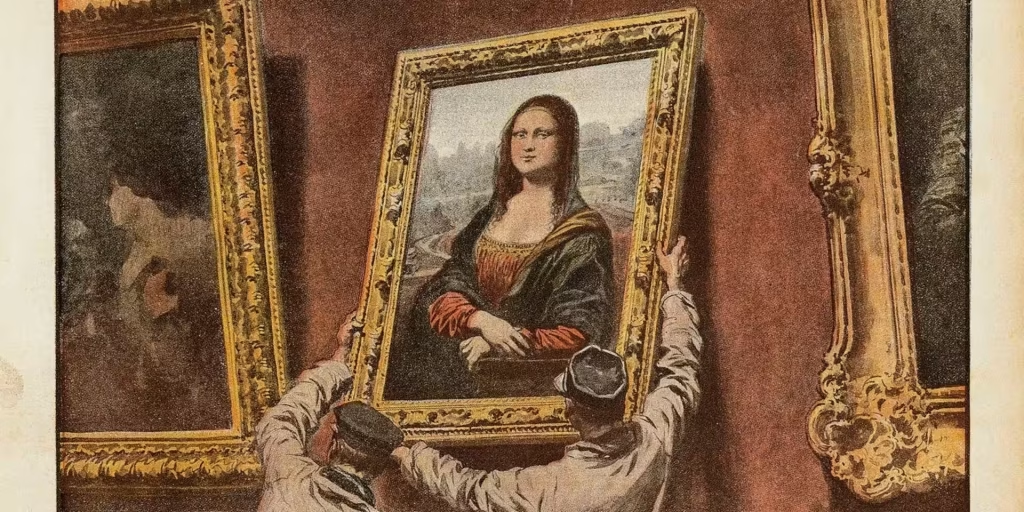
After a couple of years, Peruggia left his job at the Louvre, but his time at the museum did not end there. On the quiet maintenance morning of August 21, 1911, dressed in his standard Louvre employee uniform, Peruggia snuck into the museum with no questions asked. He found himself in the Salon Carré and patiently waited for other clueless employees to finish their duties. Once they had left, he carefully picked up the Mona Lisa from the wall and scattered to the service stairwell. 

There, he utilized his mastery of protective case frames and efficiently removed them and forced himself into a closet where he would stay for the rest of the day. And once the museum finally cleared out, he wrapped the painting in his coat and dashed out.

And this officially marks the heist of the 20th century, the heist that started it all. 

Later on, when cleaning staff saw the painting had been removed, they did not dare to investigate, automatically assuming that it had been swiped for repairing or inspection services. It wasn’t until the artist Louis Beroud noticed the blank wall, where the painting had sat, and immediately called security, eventually leading to a 48-hour shutdown of the museum.

The scandal had completely blown up in the media and the larger world. Nobody had known the Mona Lisa, yet everyone was fascinated by the heist. Who stole it? How did they do it? What were the motives? Where is the painting now? And why the Mona Lisa?

The New York Times reported it as the crime of the century. The Washington Post accidentally published the wrong painting when announcing the theft. People around the world curated new conspiracy theories each day on where it was located, from the U.S., Japan, to Russia. 

Many French newspapers fueled and grilled American art collectors and tycoons, such as JP Morgan and vast American millionaires, with accusations of having commissioned the heist to snatch France’s cultural heritage for themselves.
French police investigated every corner. They stopped ships, questioned avant-garde artists such as Pablo Picasso and Guillaume Apollinaire, and hundreds of others. In fact, they were able to find some crucial clues along the way, including the fingerprint on the protective glass stain Peruggia had removed, and even got close enough to the point where they interviewed Peruggia twice, but still assessed no suspect probability. 
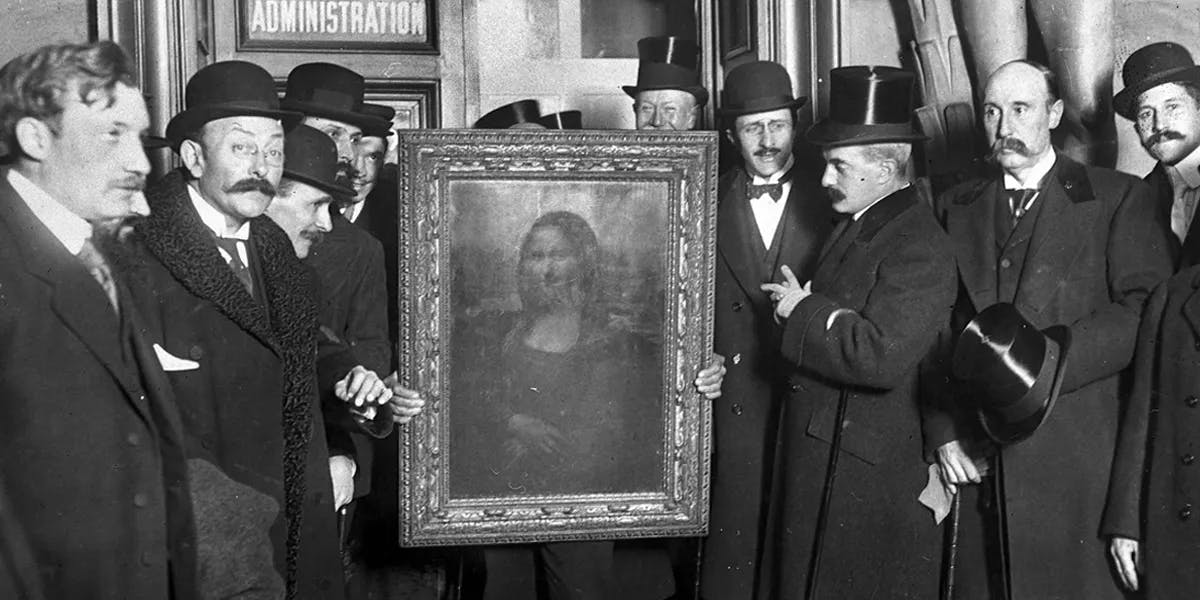
The Incredible 1911 Theft of the Mona Lisa | Barnebys Magazine

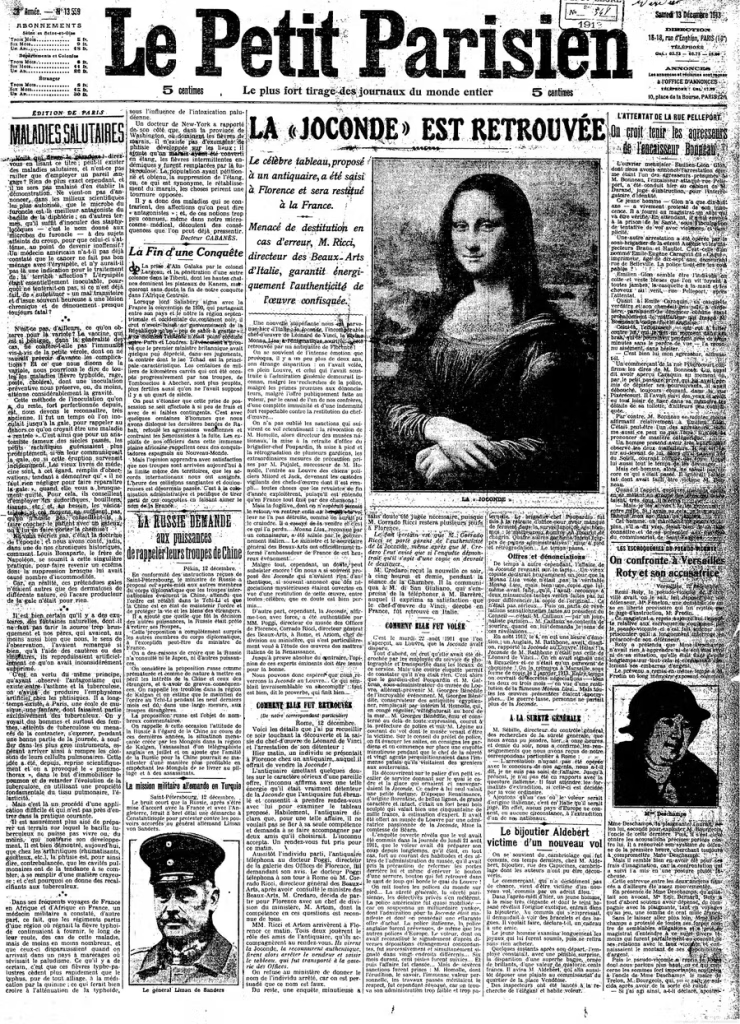
It wasn’t for another two years that they eventually identified Peruggia as the thief following his attempt to sell the painting to an art dealer in Florence. 

The 28-month global-spanning frenzy led to the birth of the Mona Lisa. Even before its official return, over 120,000 people visited the Louvre just to see the space where it hung. 

And although the heist gave name and fame to the most well-renowned art in the world, it also revealed something greater about society and the way we view art. 

Movies have depicted and glamorized countless heists, further illuminating society’s century-long fascination with theft. The phenomenon of a victimless crime that challenges wealthy institutions gives a thrill to what is the unknown. 

Therefore, it is crucial to question why society becomes captivated with stories of theft. Further illuminating that maybe it isn’t the art itself but what lies before it, how it got there. 

And what does a heist provide? A sensation for investigation, a mind open for imagination, and a mystery that needs to be solved.

Categories
In Case You Missed It Museum Events

McMullen Art After Dark: Fall 2025

By: Emily Barnabas ’26

The Student Ambassadors hosted their biannual student opening at the McMullen Museum of Art on September 5, 2025, debuting three feature collections: Medieval | Renaissance, A Fresh Vision, and Martin Karplus. With overflowing trays of charcuterie and platters of cannolis, students enjoyed crafts, games, live performances, film, and of course, new art!

Sexual Chocolate started a night of memorable student performances. Gathering a sizable crowd in the museum’s glass atrium, the all-male step group stunned visitors with their set and finished their performance to loud applause. Acapella performances by The Dynamics, The Common Tones, and The Acoustics followed, creating a joyful and energetic atmosphere. BC’s Music Guild wrapped up the night, showcasing a variety of talented individual performers and bands.

The Daley Family galleries on the second floor, the temporary home to Italian Medieval and Renaissance art and Belgian landscape paintings from the Tervuren artist colony, were transformed into crafting spaces where students crowded around tables to make framed mosaics and felt figures. With ceramic pieces and small gemstones spilled onto tables, students spent time laying their designs, applying grout, and sealing their creations. 

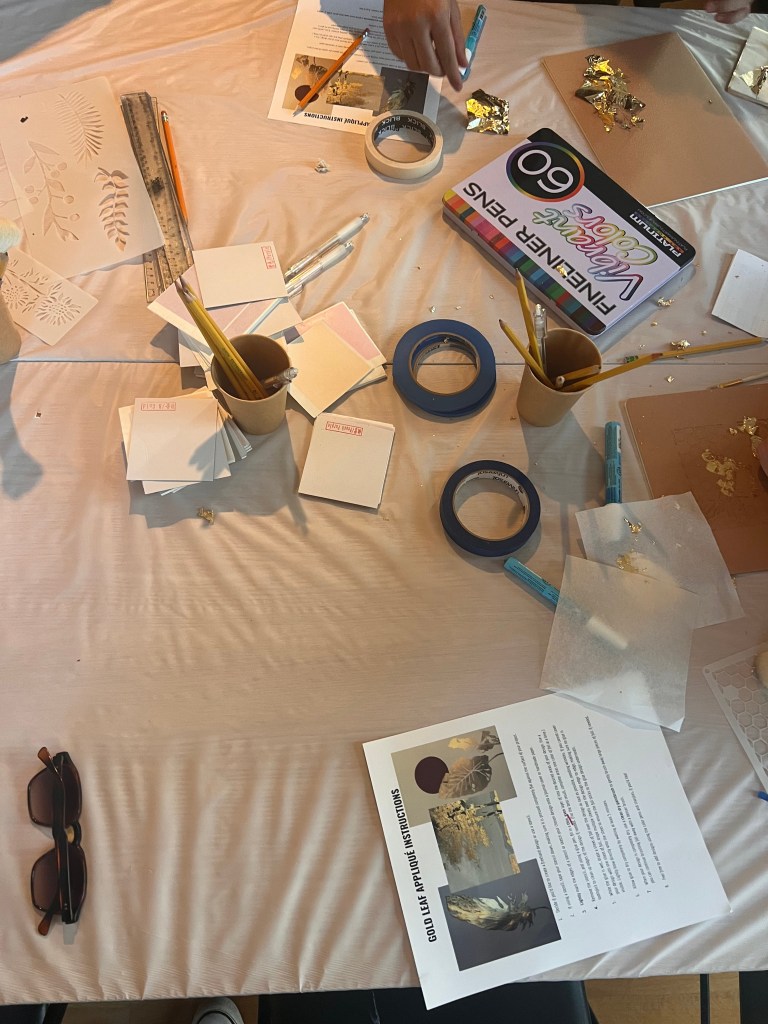
In the 3rd floor gallery, next to the collection of post-war photographs by Nobel Prize-winning chemist Martin Karplus, was a space dedicated to making gold-leaf motifs. A nod to the ornate use of gold embellishment in works of the Medieval | Renaissance, student ambassadors showed visitors how to prime, adhere, and apply gold leafing to their stationary item of choice.  

A beloved tradition of Art After Dark, indoor and outdoor games remained popular throughout the night. Inspired by the featured collections, participants tried their hand at Italian board games like Scope, Briscola, and Tressette, as well as Renaissance classics such as Tuscany, Citadels, and Trade and Triumph. The fun continued outdoors where visitors enjoyed the summer evening with lawn games like Axe Throwing, Giant Yahtzee, Giant Connect Four, Giant Jenga, and Lawn Bowling. Offering a break from all the entertainment, Moby Dick and other movies played continuously in the 1st floor galleries to offer students a place to enjoy food, drinks, and good company.

However, one of the most popular activities of the night was the Art After Dark Scavenger Hunt, affording winners the opportunity to pick their choice of a McMullen t-shirt or hoodie. Visitors dashed between floors, through galleries, and raced to find an ambassador to claim their prize. A favored tradition of Art After Dark, the scavenger hunt offers visitors a way to engage and explore the museum in a more meaningful way–-rewarding lucky winners with signature McMullen merch.

The McMullen Museum’s exhibitions showcase a diverse spectrum of artistic vision across centuries. Medieval | Renaissance presents nineteen rarely seen works from Florence’s Frascione Collection, tracing the evolution of Italian painting from the late thirteenth to early sixteenth centuries and exploring the transition between medieval and Renaissance art. A Fresh Vision highlights a transformative gift of thirty-six nineteenth-century Belgian landscapes from the School of Tervuren, celebrating artists who turned to nature for truth and renewal amid modernity’s rise. Complementing these historical collections, Martin Karplus: Photographic Journeys features fifty-five vibrant digital prints from the 1950s and 1960s, revealing the Nobel laureate’s humanistic lens on a changing postwar world. See all of these exhibits, as well as our featured first floor permanent collection, until December 7, 2025.

Categories
Art Abroad

Art Abroad: Vevey’s Images Festival

By: Emily Barnabas ’26

Tucked away on the north shore of the Lac Leman lies Vevey. A true jewel of the Swiss Riviera, Vevey is known for its panoramic lake views, terraced vineyards, and surrounding Alpine scenery. Home to the world headquarters of Nestle and Charlie Chaplin’s former residence until his passing in 1972, the town has evolved into a destination for food and culture. However, Vevey has recently established itself as the host city of Switzerland’s leading visual arts festival, organizing the acclaimed Images biennial celebration.

And I can attest: During my semester abroad this past fall, I had the incredible opportunity of being able to participate in a homestay based in Vevey and experience the wonder of Images firsthand. 

Every two years, Vevey’s Images invites the worldwide arts community to experience made-to-measure indoor and outdoor photography exhibitions, interactive monuments, and other varied forms of scenography. The purpose of Images is to highlight the assets of the Swiss Riviera through tailor-made installations and experiential exhibits. The theme of the 2024 Images festival was (DIS)CONNECTED; drawing inspiration from Chris Marker’s Letter from Siberia in which he expresses, “It is pretty rare to be able to take a walk in an image of childhood”. The festival’s collection was curated to craft the experience of childhood nostalgia; specifically, considering how the exhibitions could evoke the “vague but ever-present feeling that reveals both the instability and excitement that surrounds us.”

One of my favorite ways to spend time in Vevey was to simply go for a walk: along the lake esplanade, past new cafes, through neighborhood parks, and by quaint squares. In turn, I discovered a new piece of the Images festival every time I went on a walk. Over the course of my time in Vevey, I grew to appreciate certain works more than others, finding myself returning to particular parts of town to re-experience my favorite pieces. 

Belle Epoque is the largest work of the Images collection. Spanning 1,000 square meters, this tarpaulin was installed on the front of the Nestle headquarters building. Aside from the sheer size of Belle Epoque, its installation on the sea-colored glass right in front of the glimmering waves of the Lac Leman made it seem like the ship was actually on the water, providing a stunning facade. The image itself is rather basic; yet, it represents the longer history and tradition of paddle steamboats in the Canton de Vaud. Emerging with the establishment of of the Compagnie Générale de Navigation, the major steamboat operator of the region, these fleets became an integral part of the lake scenery. When asked about the deeper meaning behind Belle Epoque, creator and photographer Vincent Jendly evoked that paddle steamboats are reminiscent of childhood trips on the lake as well as the memories of passing tourists and residents.

A landmark of Vevey that I found particularly amusing was the Musee Suisse du Jeu, or the Swiss Museum of Games. The museum is located in the Château de La Tour-de-Peilz, an idyllic building which sits on a small hill overlooking the shores of the lake. The grounds’ hilly greens displayed Benjamin Freedman’s Positive Illusions, a collection of photographs and computer generated images which depict the artist’s experience of a family road trip from Montreal to Maine at the age of 9. Freedman’s whimsical exploration of contrasting colors, shapes, textures, and childhood motifs is intended to transport viewers into the joyous world of childhood. Yet, Freedman’s utilization of CGI challenges how childhood nostalgia and memory can be reassembled by technology.

The location of Positive Illusions truly enhanced its meaning as families and children would often walk through the outdoor exhibit after visiting the Museum of Games. On days where it was sunny, the image panels would blow softly in the lake breeze, representative of the fleeting nature of childhood and emulating its temporality.

Hess and Polli’s One Bed, Two Blankets, Seventy-Six Rules was one of the premier installations of the Images festival; centrally located to the main town square and lakefront promenade, this installment invited visitors to walk amongst it and truly immerse themselves in art. While each photograph focuses on a different focus and subject, the project was created to represent unique qualities of Hess and Polli’s relationship and life together. Additionally, the couple’s installation offers an evolved interpretation of the sacred rules and standards that are established by couples who live together. Revised and reworked at residencies including the Val Verzasca and La Becque, Hess and Polli’s piece is a testament to the evolving and dynamic nature of long-term partnerships. An incredibly emotional and authentic installation, One Bed, Two Blankets, Seventy-Six Rules depicts domesticity and cohabitation as processes that are synonymous with revision, negotiation, and discovery. 

In reflection, I feel extremely lucky to have had the opportunity to experience the Images festival in Vevey and gain meaningful insight into contemporary art on a global scale. What I loved most about the Images festival was the experiential component; with integration into the environment and local establishments, the careful presentation of each piece added depth to its original meaning. Blurring the boundaries between art and everyday life, Images allows for the contemplation of how context can transform perception.

Sources

  •    Vevey Images Presskit: Excerpts on Belle Epoque, Positive Illusions, One Bed, Two Blankets, Seventy-Six Rules (September 2024)
  •  Chris Marker, Letter from Siberia (1958)