Categories
Into the Collection

A McMullen Winterlude

By: Emily Barnabas ’26

Winterlude, let’s go down to the chapel

Then come back and cook up a meal

Well, come out when the skating rink glistens

By the sun, near the old crossroad sign

The snow is so cold, but our love can be bold

Winterlude, this dude thinks you’re fine

Winterlude by Bob Dylan may be one of the best snow day songs. By capturing the essence of a slower, simpler life, Dylan’s lyrics evoke the quiet magic and new possibility that arrives with snowfall. With over 20 inches of snow falling in late January, Boston College students enjoyed a winterlude of their own. Whether they were socializing at the “Snarty” in the Mods or curling up with hot chocolate on the couch, the storm provided a welcome reprieve from the frantic start of the semester. 

Moments of winterlude have been documented in art for ages. Whether it be written recollections or visual representations, there is something special about the way that snowfall makes us pause and reflect. The Permanent Collection of the McMullen Museum of Art features several notable snow scenes, those of which capture the transformative nature of winter. In celebration of this season, this feature will highlight selected works from the Permanent Collection, discussing how artists across periods and styles have interpreted the spirit of this time of year.
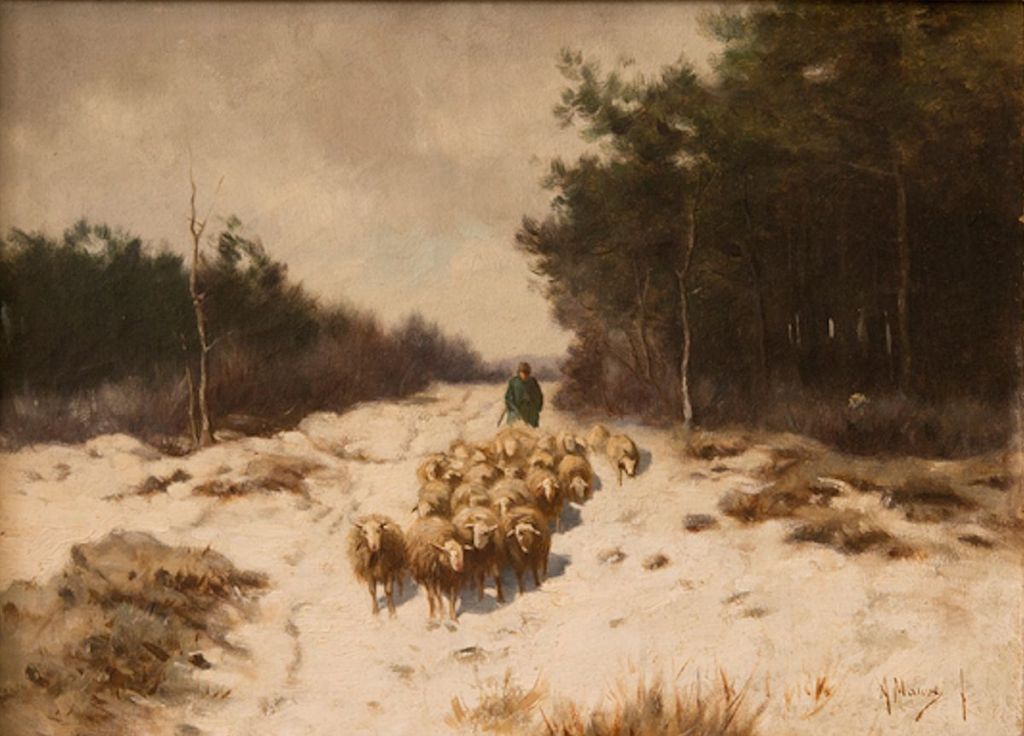
Anthonij (Anton) Mauve (1838–1888)
Snow Scene with Sheep, c. 1882–88
Oil on canvas, 9.3 x 12.5 in.
McMullen Museum of Art, Boston College, 1988.91

Snow Scene with Sheep depicts a tranquil scene of a clustered flock of sheep with a shepherd trailing nearby in the background. Hands stuffed deep into coat pockets and bundled in layers of dark green, the shepherd’s dedication to tending their flock through the winter chill can be interpreted as a metaphor for social and spiritual care (Howe). Mauve’s use of tonal gradations and soft brush strokes create the illusion of depth, signaling the distance that the flock has traveled. When looking at this work, one may imagine the solitude of this journey and sense the resilience needed to persist through such a landscape. In this suspended moment, the subjects’ movement feels slow and deliberate, each step through the snow symbolizing steadfast care in the midst of nature’s austerity. 
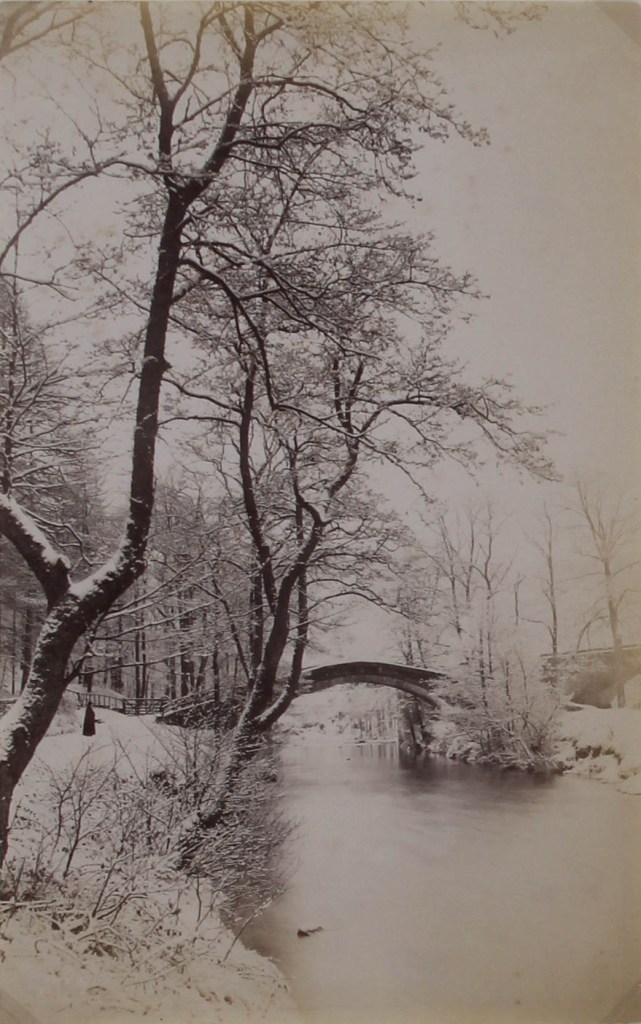
Frank-Meadow Sutcliffe (1853–1941)
Beggars Bridge, Yorkshire in Snow (near Whitby), c. 1900
Albumen print, 8 x 5 in.
McMullen Museum of Art, Boston College, Gift of David L. Mahoney and Winn Ellis, December 2002, 2002.51

Viewing Sutcliffe’s Beggars Bridge is like listening to Fleetwood Mac’s Landslide, exuding feelings of longing, seclusion, and tranquility.

Then I saw my reflection in the snow covered hills

Til the landslide brought me down

An Albumen print, a method of producing photographic print using a mix of egg whites and salt, this intricate snowscape is brought to life in the small fibers of silver nitrate that bind to the paper. Taking a closer look, the variety of lines—visible in the delicate tree branches and gentle curve of Beggars Bridge—guides the viewer’s eye across the composition with soft intention. Placing emphasis on the subtle impressions left in the snow, this graceful scene carries a deeper emotional weight that is reflective of a literal and symbolic passage through the isolation of winter.
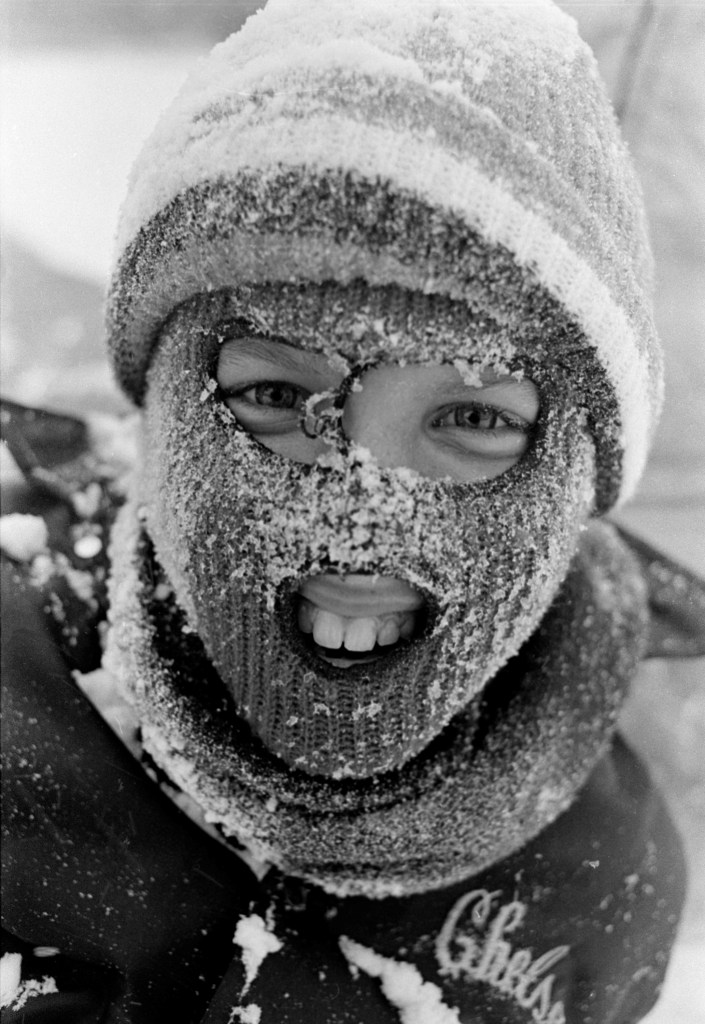
Arnie Jarmak (1949–)
Snow Mask, Blizzard of ’78, 1978, 17 x 10.125 in.
McMullen Museum of Art, Boston College, Gift of the Artist, 2021.71

Following a snowstorm in February of 1978, Jarmak took his camera on a stroll to capture the impact of the historic snowstorm which struck the area. Photographing along the Mystic River (Tobin) Bridge, the local cantilever truss bridge which connects Boston and Chelsea, Jarmak encountered an instance of pure joy and winterlude. What appears as a photograph of a masked, but grinning, child in the snow represents so much more: “a recognition of [their] humanity made visible in the final print” (Andersen & Larsen). Jarmak’s photograph tells an additional narrative of Chesela’s community, one rich in internal pride and resilience. Through the photographic medium, Jarmak’s striking portrait reminds audiences that moments of joy should not be overlooked during times of hardship.

Works Cited

Howe, Jeffrey. “Snow Scene with Sheep.” McMullen Museum of Art, Boston Collegehttps://mcmullenmuseum.bc.edu/anthonij-mauve-snow-scene-with-sheep/. Accessed 9 Mar. 2026

Arnie Jarmak: Photographing Chelsea in Transition, 1977–89. Edited by Ash Anderson and Diana Larsen, McMullen Museum of Art, Boston College,2022. https://bcweb.bc.edu/mcmullen/exhibitions/jarmak/Jarmak.pdf. Accessed 9 Mar. 2026.
Categories
Into the Collection

Into the Collection Spotlight

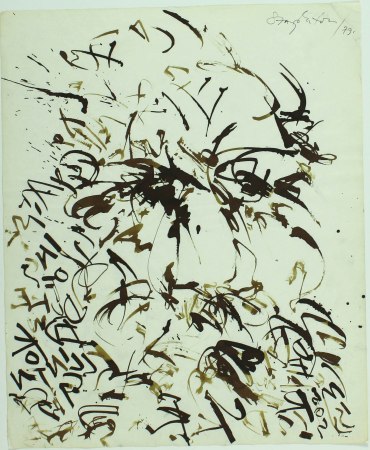
Joseph Stapleton (1921-1994) Thinking of Duke Ellington, 1979 India ink on paper, 17 x 14 in.

By Liam Conner, class of ’25

Joseph Stapleton was one of the many artists who populated New York City following the wars of the early 20th century. As a member of Abstract Expressionism’s “second generation,” Stapleton and others were heavily influenced by international culture, social movements, and artistic creativity. As shown in Stapleton’s Thinking of Duke Ellington, the seemingly spontaneous and erratic brush strokes combined with what seems to be text throughout the border work to create a portrait of Duke Ellington like none other. Painted approximately five years after The Duke’s death, the work expresses his longstanding legacy through its aberration from form. Ellington’s music throughout his career was revolutionary, and this image articulates that with its quick and almost swing-like strokes that hop around the canvas. Heavily influenced by Japanese calligraphy, Stapleton unconventionally incorporates themes from throughout the world in the same way that Duke Ellington wrote music with Latin and European cultures in mind. Stapleton’s interpretation of the great composer in Thinking of Duke Ellington provides a look not only at his own era but also at the impact of Duke Ellington and his legacy on the greater artistic community.

Sources:

Duke Ellington: American Musician. See https://www.britannica.com/biography/Duke-Ellington#ref344119. Accessed 9/23/2022.

New in Artstor—Nearly 300 Self-portraits by Joseph Stapleton: A Unique Offering from a Second Generation Abstract Expressionist. See https://www.artstor.org/2019/11/05/new-in-artstor-nearly-300-self-portraits-by-joseph-stapleton/. Accessed 9/23/2022.

Categories
Into the Collection Uncategorized

Into the Collection: Twentieth Century Prints

By Alyssa Trejo

On Wednesday, April 11th, the McMullen exhibited twentieth-century prints from our private collection as part of the ongoing Into the Collection series. Student Ambassadors from the Education Committee presented on prints ranging from lithographs, woodblock prints, sugar-lift aquatints, and more from artists like Picasso, Kokoschka, and Maher.

Into the Collection 1

Alyssa Trejo researched and presented information on Georges Rouault’s Plate 36: Ce sera la dernière, petit père / This will be the last time, father! from the Miserere series. Members of the audience were stunned by the strong contrast and its dreary imagery.

Georges Rouault (1871–1958), Miserere et Guerre, c. 1920, etching on paper, 25.75 x 20 in. McMullen Museum of Art, Boston College, Gift of Ms. Ruth Shikes, 2009.31

The first print depicts a father, who was once a soldier, kissing his son goodbye before he leaves to go to war. As he does so, the son says “this is the war to end all wars.” Death, in the form of a skeleton, foreshadows the imminent demise in this war and in those to come, thus proving the son wrong.

This plate is especially telling since it was made during WWI, but not published until after WWII. It asks the viewer to contemplate our views on war and the destruction it causes, and whether or not we honestly learn from it.

The project was conceived as two volumes, titled Miserere and Guerre, to be made up of 100 large etchings with accompanying text by poet André Suarès. The books were never actualized, but instead resulted in a series of images made by Rouault. The artist himself prepared the plates through etching, which uses baths of acid to bite into the surface of the plate. More specifically Rouault used aquatint, in which rosin is applied in a fine powder and melted to the plate. The acid then etches the tiny spaces in between the motes of rosin, making a matrix of indentations that produce characteristically deep and textured black and greys in the final prints. He also used Sugarlift, where one takes a brush directly to the print using water and sugar and applies rosin to the unbrushed areas to leave a negative area of exposed plate. This negative area is then treated using the aquatint technique.
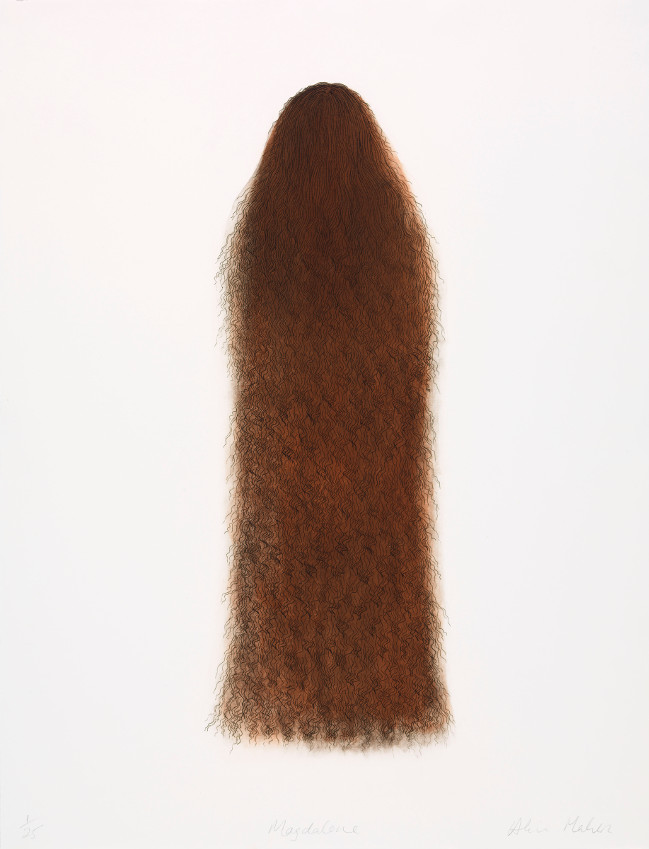
Alyssa also presented on Alice Maher’s print Magdalene. Although simplistic in its appearance, the print tells a story about Mary Magdalene and the importance of her femininity.

NGI 20882

Alice Maher (1956–), Magdalene, 1998, etching on Johannot paper, 26 x 19.5 in. McMullen Museum of Art, Boston College, Gift of Friends of Art, 1998.4

Human hair is a recurring motif in Maher’s work. Almost every character in her sketchbook has long hair. In this work, Silvestro dei Gherarducci’s painting from the 1380s The Assumption of St. Mary Magdalene inspired her. It shows Mary Magdalene during her assumption, with hands folded in prayer and her body completely covered by her long hair.  In Maher’s interpretation, there is simply the form of long red hair standing by itself. This emphasizes the femininity of Magdalene. We are left to remember that she was not only a great Christian symbol of repentance, but also a woman, something significant within the patriarchal system of Christianity. This contemporary feminist point of view adds a new dimension to Maher’s work and the image of Mary Magdalene we have today.