Categories
Exhibition Spotlight

Martin Karplus: A Human and Worldview Approach to Photography

By: Elona Michael

This fall, the McMullen Museum’s third floor features an exhibit consisting of fifty-five digital prints taken by Nobel Prize-winning chemist Martin Karplus during his travels across Europe and North America in the 1950s and 1960s. Known for his groundbreaking work in developing computer-based models for complex chemical systems, Karplus managed to defy expectations by also pursuing his deep passion for photography. Through taking a multitude of photographs, meeting people from all walks of life, and drawing on his personal experience that shaped his strive for exploration and academic curiosity, Karplus’s exhibit and life’s work truly encapsulate the bridge between science and art, in addition to the art of being human. 

At the young age of 8 years old, Karplus and his family fled Nazi-occupied Austria for the United States following the arrival of German forces in 1938. Leaving everything he knew to live in a foreign land, he found himself drawn to chemistry during his time at Newton High School. It was from there, Karplus attended Harvard University for undergrad, and eventually Caltech for his doctorate program. Following his graduation from Caltech in 1953, his parents gifted him a Leica camera, and that is where the magic started. 
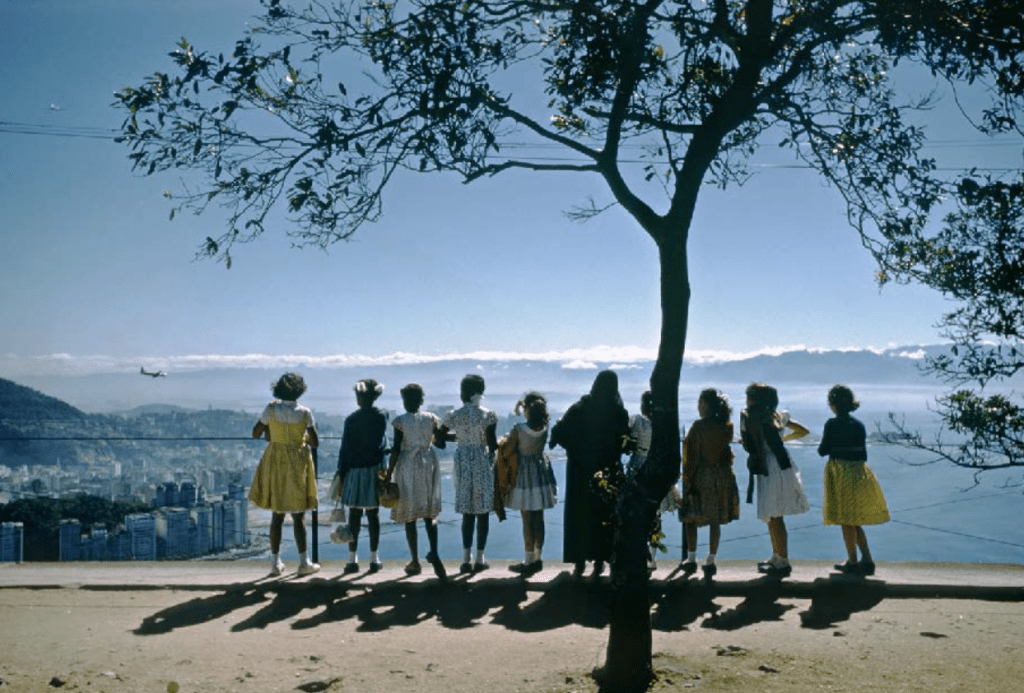
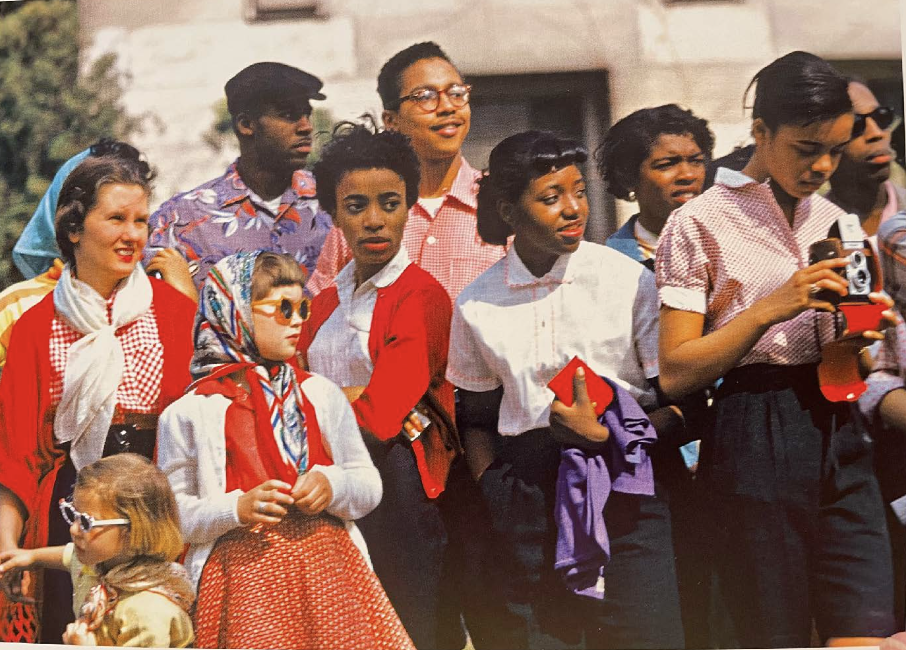
During his postdoctoral fellowship studies at Oxford at 23, Karplus utilized this opportunity to step away from his traditional academic schedule and take photos during his travels. With just a Volkswagen Beetle and his camera, he was able to capture vast cultures, everyday people, beautiful architecture, and authentic cuisine. And in a post-World War II and Cold War society filled with growing sentiments of competition and disconnection, Karplus’s documentation served as a rich portal, highlighting the reconstruction and resilience of different societies during this time period, focusing on fundamental human emotions and connections. 
Decades later, in 2013, Karplus received a Nobel Prize for his research efforts toward the development of multiscale models for complex chemical systems. Because of his lifelong commitment and curiosity for chemistry, from receiving his first Bausch and Lomb microscope as a teenager to his later study of the bifluoride ion, he was able to utilize this pursuit and later transfer it into his photography journey.
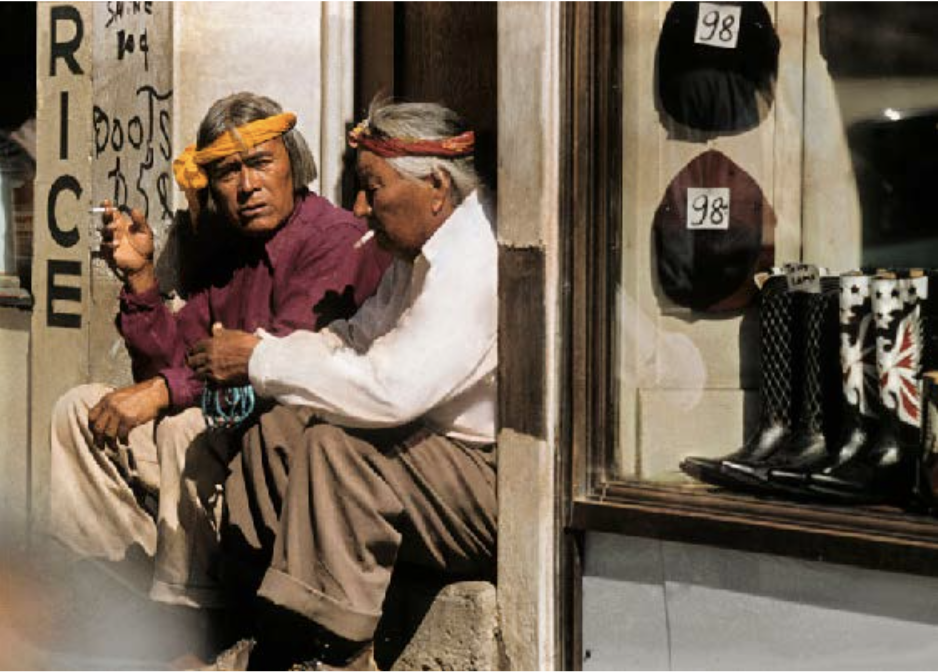
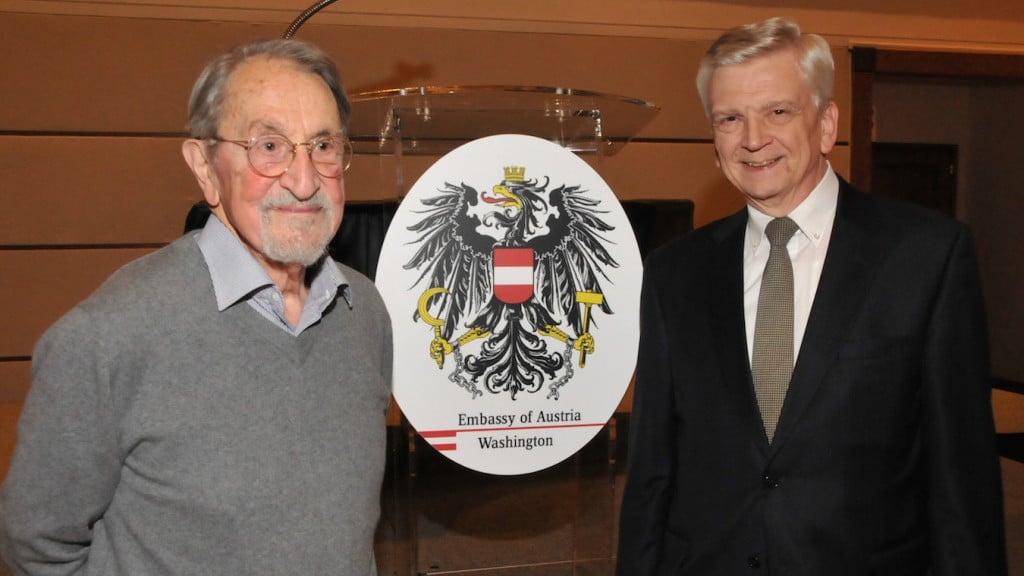
In 2015, Karplus gave back to his country of origin, exhibiting his groundbreaking collection in the Austrian embassy in Washington. Guests were greeted by his photographs from all over the world. His collections feature vivid pops of color paired with incredible interconnected relationships between landscapes and people. For example, one of his collections features schoolgirls walking in a line with bright pink skirts in Rome, Italy, and another shows Diné men sitting and smoking cigarettes in a doorway in Gallup, New Mexico. 
These symbolic messages presented sentiments of hope and despair, youth and old age, and quiet and loud. But most importantly, it captured the simplest yet universal qualities of human nature. Karplus’s precision to detail alongside his lifelong efforts of curiosity, science, and observation allow him and the vast viewers of his works to explore the everyday moments and indulge themselves in the lives of others.

Right before he died in 2024, Karplus and his wife gifted 134 digital prints of his photography to the McMullen Museum. Now, they stand ready to be viewed by students and professors at BC and beyond, living out Karplus’s legacy of crossing borders, documenting and observing the diverse world around us, ready to be explored. 

Categories
Exhibition Spotlight

Laudato Si’ and Wonders of Creation in Dialogue

By: Chase Gibson ’26

In May of 2015, Pope Francis released his encyclical Laudato si’, a call to care for our common home. In his closing prayer, he writes:

All-powerful God, you are present in the whole universe

and in the smallest of your creatures.

You embrace with your tenderness all that exists.

Pour out upon us the power of your love,

that we may protect life and beauty.

The McMullen Museum of Art has the privilege of exhibiting Wonders of Creation. The exhibit contains a cosmography by the Islamic judge and professor named Zakariyya ibn Muhammed al Qazwini with an encyclopedic description of the wonders and rarities of the universe from the Heavens to the Earth. In the same spirit as Pope Francis, Qazwini investigated the world with a sense of wonder. He defamiliarized the familiar and documented the world because of its inexplicability. The rare, the wonderful, and the mysterious can be found in the pages of Qazwini’s cosmography.

Pope Francis criticizes “throwaway culture,” a mindset that views the Earth and its creatures as objects to be used, exploited, and discarded. He warns that this consumerist logic dulls our sense of awe and weakens our moral responsibility to care for creation. Though centuries apart, Qazwini and Pope Francis both issue a call to wonder. For Pope Francis, it takes the form of Laudato si’, a summons to care for ‘our common home.’ For Qazwini, it was cataloging creation to better understand God’s design. Their works challenge us to cultivate awe not for consumption, but for protection.

Qazwini’s work is marked by an insatiable curiosity. Medieval Islamic scholars called this attitude towards nature taʿajjub, or marveling. This marveling was not childish distraction, but the root of devotion. Pope Francis, too, advocates for this attitude when he speaks of creation as a ‘joyful mystery.’ Their works encourage a spiritual discipline of attentiveness, an act of seeing that becomes praise.

Qazwini documented Sheep (gusfand), The Islands and Strange Animals of the China Sea (‘Abd al-Majid), Constellations of the Centaur and Lion, and Cuttlefish, Crab, and Skink. He recorded the characteristics, attributes, and uses of these phenomena to better understand God’s creation. Qazwini believed that his research allowed him to reach higher states of knowledge for contemplation and appreciation of divine creation. His object of study carried talismanic value, useful for healing and protection. Yet Qazwini’s interest in the universe extended beyond mere utility. He believed that the subjects of his study had value for their utility as well as their beauty. 

In an era where data often overshadows meaning, Qazwini’s work invites a reconsideration of how we study the world. He studied animals not to dominate them, but to learn from them. His cosmography reads as both science and scripture in an effort to trace divine fingerprints across the cosmos. Pope Francis echoes this when he warns of a ‘technocratic paradigm’ that disconnects us from nature.

Pope Francis believed that science is a gift from God and a tool for the preservation of humanity. It is through science and technology that humanity can find the solutions to climate change and pollution. The Pope wrote, “We need only take a frank look at the facts to see that our common home is falling into serious disrepair… Hope would have us recognize that there is always a way out… science and religion can enter into an intense dialogue fruitful for both.” While science and technology are necessary to care for humanity, ethics and spiritual wisdom have their role in guiding humanity toward the common good. 

Pope Francis and Qazwini were both religious men who saw the Earth and its inhabitants as divine creation. They are united by a common interest that transcends their religious differences. In the age of interfaith dialogue, Qazwini’s cosmography is a powerful reminder that the pursuit of knowledge has long served as common ground between Islamic and Christian traditions. Both Pope Francis and Qazwini challenged the modern notion that faith and reason are at odds. Their shared reverence for the natural world encourages a renewed conversation between science, spirituality, and stewardship across religious boundaries.

The McMullen’s exhibit invites us to recover a sacred way of seeing. Qazwini’s pages urge us to pause, marvel, and learn; Pope Francis called us to act with urgency and compassion. Their voices, one medieval and one modern, remind us that creation is not ours to dominate, but to cherish. Between them, they offer a roadmap not just for understanding the world, but for protecting it.

Wonders of Creation: Art, Science, and Innovation in the Islamic World will be in the Daley Family and Monan Galleries from February 9 to June 1, 2025. 

Categories
Exhibition Spotlight

Reflecting on the States of Becoming Exhibit

By: Chase Gibson ’26

States of Becoming is an exhibition curated by Fitsum Shebeshe that displays contemporary art in the African diaspora, and the exhibition brings together seventeen African artists from twelve countries who relocated and resettled in the United States. Their art shows their struggle to come to grasps with the conflict of their African heritage and the dominant American cultural paradigms. The artists share their experiences with culture, identity, belonging, and discrimination through various methodologies. 

There are three groups of artists. First, there are artists whose relocation prompted them to make aesthetic transformations, creating what are called hybrid aesthetics. Second, there are artists who share the stories from their origin country to their communities in the United States. Third, there are artists who use their art to draw connections between the African Diaspora and the United States. States of Becoming hosts the work of artists who find themselves and a sense of belonging through their work as they construct hybrid aesthetics and cultures.

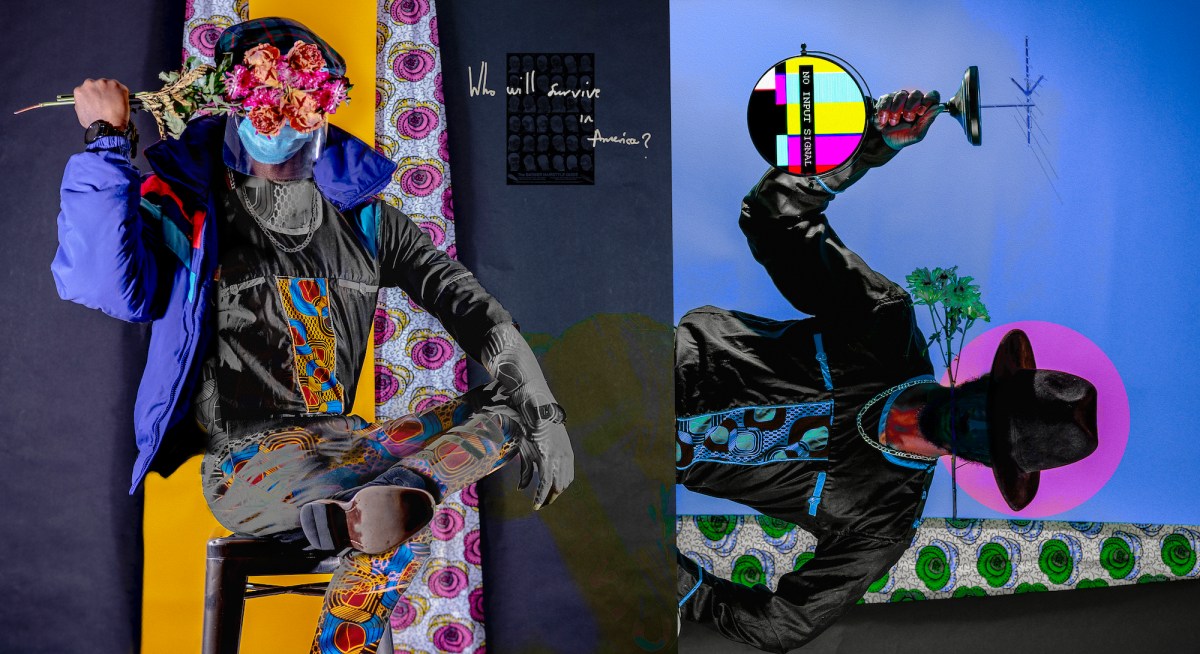
Chukwudumebi Gabriel Amadi-Emina is a Nigerian American photographic and video artist whose work Bombu Afomo / MineSweeper (2020) explores what it means to be African American from the perspective of someone who assimilates into American culture as a black African newcomer. Amadi-Emina depicts himself as a soldier in the war on racism, implementing elements of his Nigerian identity with his new African American identity. Amadi-Emina constructs a new version of himself, creating an identity altered by his relocation, a hybrid aesthetic.

Yvonne Osei is an artist from Ghana that addresses racial categorization through her work Between the Voids (2012) which explores the effects of the black and white dichotomy on identity in the United States. Osei comes from the Ashanti Kingdom in Ghana, where her blackness is a thing of pride. However, in her new home, her blackness is reduced to something to be categorized which fails to capture the spectrum of racial identity. Osei’s work rejects attempts to draw a line between white and black. Instead, Osei challenges whether the line matters at all.

Kern Samuel is a Trinidadian artist living in New Haven who attempts to find meaning in an ever changing context. Samuel used drawing, painting, and sewing along with spices and dyes to create An Island (2021) depicts Samuel’s struggle with self-representation without creating an abstraction of self. Samuel’s work uses the language of materials to evoke his childhood in Trinidad as a reflection on his cultural identity. The artist explores the significance that his Trinidadian upbringing has on his selfhood. 

Hannah Arendt and Kwame Anthony Appiah are two substantial contributors to the conversation on identity and belonging in a modern, globalized context. Arendt, a Jewish refugee herself of World War II, wrote on the importance of identity in a world that only recognizes the value of one’s opinion if they belong as citizens to a recognized democratic government. To Arendt, identity is crucial to political participation, because citizenship gives value to an opinion. She emphasizes plurality of identity and avoiding rigid or singular identities. Osei and Arendt share in their attitude towards identity as they both embrace spectrum thinking and recognize the nuances to understanding selfhood. When Osei challenges ideas of absolute racial identity like full blackness or full whiteness, she challenges racial categorization as a whole which embraces Arendt’s idea that pluralism does not look to reduce identities to simpler, less true versions of themselves.

Appiah wrote on culture as not “a box to be checked on the questionnaire of humanity; it’s a process you join, in living a life with others.” He recognizes the ever-changing nature of culture and identity. Culture is no more permanent than any one individual which means both are bound to change, develop, and evolve. As Kern Samuel depicts in his art, a sense of meaning can be difficult to find when the political, economic, geographic, or any other context is constantly changing around an individual. Appiah calls on his readers to “see ourselves as others see us.” In this way, there is a harmony between both social and private identities, and the self is continuous across both contexts. Amadi-Emina depicts in his artwork the complicated relationship, the disharmony, between social and private identities which creates a new aesthetic in an effort to culturally adapt. This new aesthetic is not made willingly but rather forced by a life contextualized by institutionalized racism.

States of Becoming will be on display in the McMullen Museum of Art at Boston College from September 9 to December 8, 2024. The exhibition features the work of fourteen other artists, all with something to say on themes of identity, belonging, culture, and oppression. They use painting, photography, sculpture, installation, and video to reimagine identity and bring light to their personal histories coping with selfhood in the United States as part of the African diaspora.