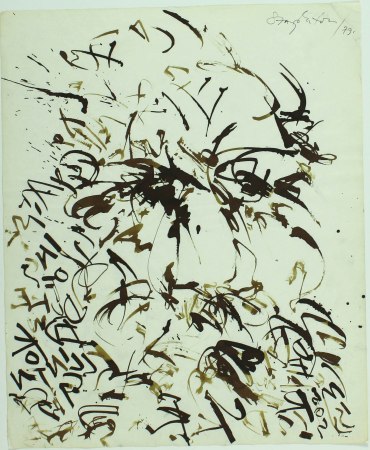
Joseph Stapleton (1921-1994) Thinking of Duke Ellington, 1979 India ink on paper, 17 x 14 in.
By Liam Conner, class of ’25
Joseph Stapleton was one of the many artists who populated New York City following the wars of the early 20th century. As a member of Abstract Expressionism’s “second generation,” Stapleton and others were heavily influenced by international culture, social movements, and artistic creativity. As shown in Stapleton’s Thinking of Duke Ellington, the seemingly spontaneous and erratic brush strokes combined with what seems to be text throughout the border work to create a portrait of Duke Ellington like none other. Painted approximately five years after The Duke’s death, the work expresses his longstanding legacy through its aberration from form. Ellington’s music throughout his career was revolutionary, and this image articulates that with its quick and almost swing-like strokes that hop around the canvas. Heavily influenced by Japanese calligraphy, Stapleton unconventionally incorporates themes from throughout the world in the same way that Duke Ellington wrote music with Latin and European cultures in mind. Stapleton’s interpretation of the great composer in Thinking of Duke Ellington provides a look not only at his own era but also at the impact of Duke Ellington and his legacy on the greater artistic community.
I am beyond grateful to have served as a Student Ambassador, member of the Education and EDIA+ (Equity, Diversity, Inclusion, and Accessibility) committees, and co-chair of the Publications Committee over the past two years. I started working during the pandemic and have had the opportunity to witness the McMullen grow and adapt to the challenges of our society, including the struggle for racial justice. Additionally, I have been able to experience several exhibits, such as Indian Ocean Current: Six Artistic Narratives and Taking Shape: Abstractions from the Arab World, 1950s – 1980s.The exhibits have introduced me to different forms of art from around the world and have made me think more critically.
The McMullen is a place that has enriched me intellectually and personally. I have met some of the most passionate, creative, and kind people, and I am blessed to have many of them as not only colleagues but friends. In addition, I have had the opportunity to work with other McMullen Ambassadors, host workshops, and implement my own ideas through collaborations with student organizations that I belonged to, such as FACES, the anti-racism organization, and BC Bigs. From the good-humored security guards to our amazing supervisor Rachel, the McMullen has fostered a welcoming and intellectually-stimulating environment that provided me with skills that I will use in future academic and professional pursuits.
Being a co-chair and member of the Publications Committee, the Terrace provided fellow Student Ambassadors and me with an outlet to critically analyze art, its nuances, and its role in our society. Through articles such as “Religious Art: Buddha is not Home Decor” and “Art as Resistance: Murals at the U.S. – Mexico Border,” I have recognized the role of art beyond something aesthetically pleasing and as a powerful tool for both social change and oppression. The publications team has engaged further in the idea of art as a tool of oppression through our series called “Problematic Visual Culture,” which discusses pieces of visual culture that perpetuate stereotypes and other forms of discrimination. We also ask questions about the ethics of how museums operate in the article “Museums and Ethics: A Series of Question.” I am grateful to have been a part of a platform that has encouraged critical thinking, new perspectives, and the inclusion of marginalized groups. Through the Terrace, the McMullen has been able to connect with issues facing communities beyond BC and uncover how important art is in the world.
I will definitely be visiting the Terrace website in the future, but as a reader rather than a writer, and I am beyond excited to see the fantastic work of all the Student Ambassadors to come. Working here has been an amazing experience, and while it is sad to say goodbye, I am so excited to pass the Terrace over to the committee’s returning co-chair: Michaela Brant (‘23), and new co-chair Joy Cheng (‘23).
During my senior year spring break, I visited a beach not part of a resort in Cancún filled with stressed college students in need of a vacation, but one lined by a wall – the U.S. – Mexico border wall. Although it would be my last college spring break, I couldn’t pass up the opportunity to physically see the borderlands instead of solely reading about them in academic courses. Thus, I decided to spend the week on an educational trip to visit the border in San Diego and Tijuana as part of a course titled “Interdisciplinary Approaches to Borderlands and Human Mobility” taught by Professor Olayo-Méndez. The trip centered on utilizing different disciplines such as biology and theology to analyze and address issues at the border. In the case of art, the trip focused on paintings and murals, and how artists can use them as a tool of resistance against discriminatory migration policies at the border.
A place in San Diego that featured art from Chicanos—Mexican-Americans—in response to harsh migration policies and dehumanizing rhetoric towards migrants is Chicano Park. Immediately, the complexity and number of murals throughout the park overwhelmed me, and I stood in front of each mural for several minutes, admiring the mix of faces and phrases. A central theme of the murals focused on the injustice of migration policies, and I felt both sadness and frustration at the lack of humanity ascribed to migrants as I walked around the park. In the mural with many crosses, phrases such as “Love has no borders!” and “No border wall” are visible. The mural draws connections between religion and migrant rights. The presence of several crosses signifies how Christianity promotes a love for one’s neighbor, which the U.S. government obstructed with the construction of a border wall.
Photo from Chicano Park of a mural saying “Love has no borders!” and “No Border Wall” painted on a bridge pillar
In another mural photographed below, one artist painted on a pier under a bridge with the phrase “La tierra es de quien la trabaja con sus propias manos,” which roughly translates as “The land belongs to those who work it with their own hands.” There are images of migrant workers in the same mural, which illustrates how jobs tilling and farming the ground in America are often done by migrants who cross the border and should be allowed to remain on the land they work. Lastly, another mural in the park pictured below contains the phrase “Ningun ser humano es ilegal,” meaning “No human being is illegal.” The mural addresses the rhetoric surrounding Hispanic migrants at the border that describes them as “illegals” to dehumanize them and justify cruel migration policies. In addition to the murals in San Diego, more paintings and murals are featured across the border in Tijuana, addressing similar issues of dehumanization and injustice.
Photo on the left from Chicano Park of a mural featuring migrant workers painted on a pier. Photo on the right of a mural from Chicano Park saying “Ningun ser humano es ilegal.”
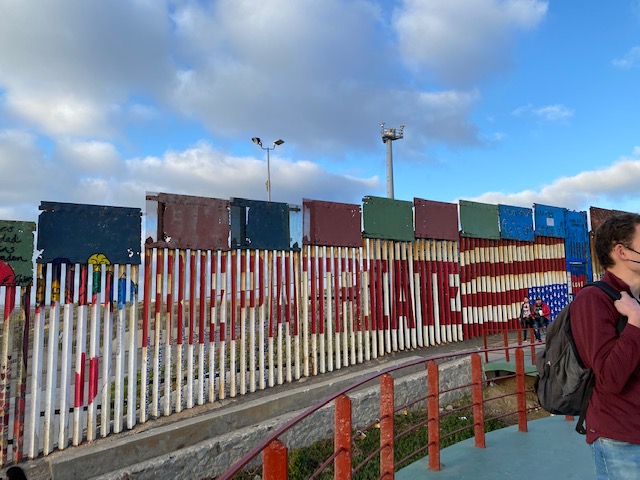
When we crossed the border to Tijuana, the colorful and mural-filled border wall on the Tijuana side surprised me. A wall that is a barrier to pursuing a better life and is constructed from racist and nationalist ideologies has become a form of art. In addition to the murals painted on it, the location of the wall also surprised me. In the photos below, the wall sits alongside a beach, where people frequently visit to spend leisure time under the rays of the sun. The wall is part of everyday life for the people of Tijuana, who cannot escape its presence even when trying to enjoy the beach. The dehumanizing wall is covered by paintings and phrases that advocate for migrants and address the injustice of the wall’s existence. For example, in the photo below, an upside-down American flag is painted alongside the phrase “Repatriate” as a reference to the deported veterans who served in the American military. The upside-down flag represents the hypocrisy of the U.S. government that permits undocumented migrants to serve in the military but not to live in the country.
Photo from Tijuana of the border wall on the beach in Friendship Park
Photo of the mural on the border wall with an upside-down American flag and the word “Repatriate”
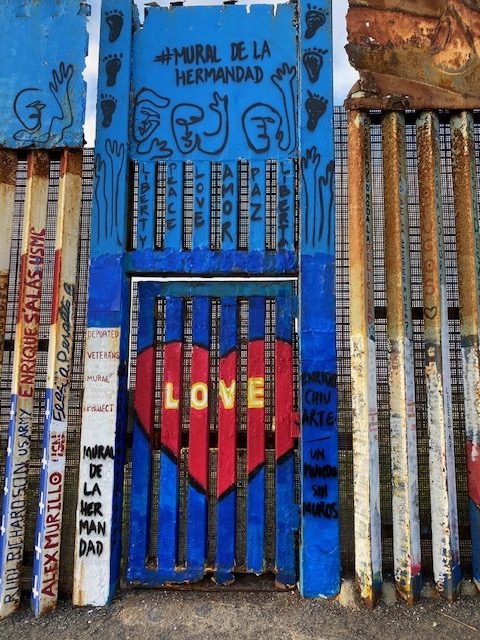
Another feature of the border wall pictured below is the blue door with the word “love” painted in yellow within a red heart. Surrounding the door are phrases such as “mural de la hermandad” or “brotherhood wall,” as well as words including “love,” “peace,” and “liberty.” The door itself, which the government rarely opens, allows families who have been torn apart by the immigration system to meet for a few minutes and for some to hug each other for the first time. The remainder of the wall meeting the ocean features portraits of deported migrants as a way to humanize and put a face to people often characterized by numbers. The border wall art and the art at Chicano Park serve as reminders of the humanity of migrants and the injustice they face due to U.S. migration policies.
Photo of the Love door in the border wall in Tijuana
Although we often view art as a pastime or something enjoyed for leisure, art is also a powerful tool of social change. The murals at Chicano Park and on the border wall in Tijuana provide us with important examples and serve as a reminder of the humanity of migrants and the discriminatory policies that we need to combat to ensure migrants’ humanity is recognized. Art is a tool of resistance, and hopefully, more artists and people will begin to realize that.