By Emily Barnabas ‘26
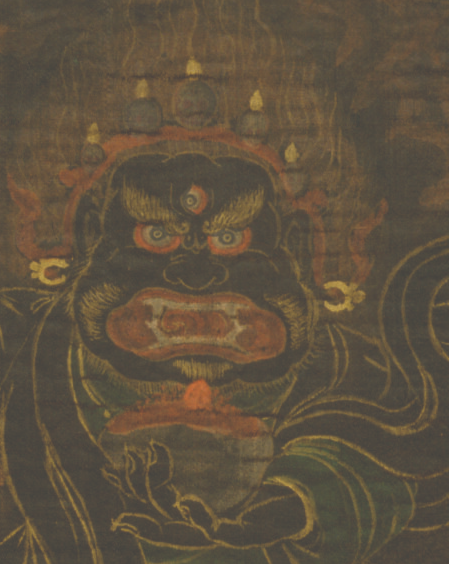
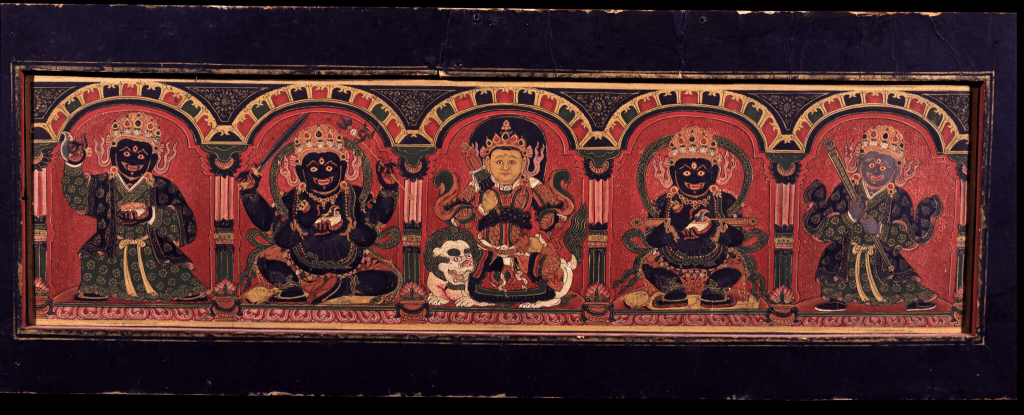
For me, Halloween can be a time filled with fear; from ghosts and ghouls to vampires and zombies; we have all come to know these creepy creatures. In my first impression, I was also fearful of the wrathful deities on display in the exhibition Gateway to Himalayan Art, currently at the McMullen Museum. These sacred Buddhist deity illustrations and religious statues have specific mythological and visual traits. Despite their seemingly ghastly expressions, flaming hair, bulging eyes, and fangs, they instead are benevolent deities, there to protect people from their worst traits and fears. Additionally, these deities’ violent expressions signify the destruction of spiritual obstacles, military strength for domination, and the eradication of worldly dangers. So, in actuality, they are contrary to European folklore’s monsters who take center stage in American Halloween representations.
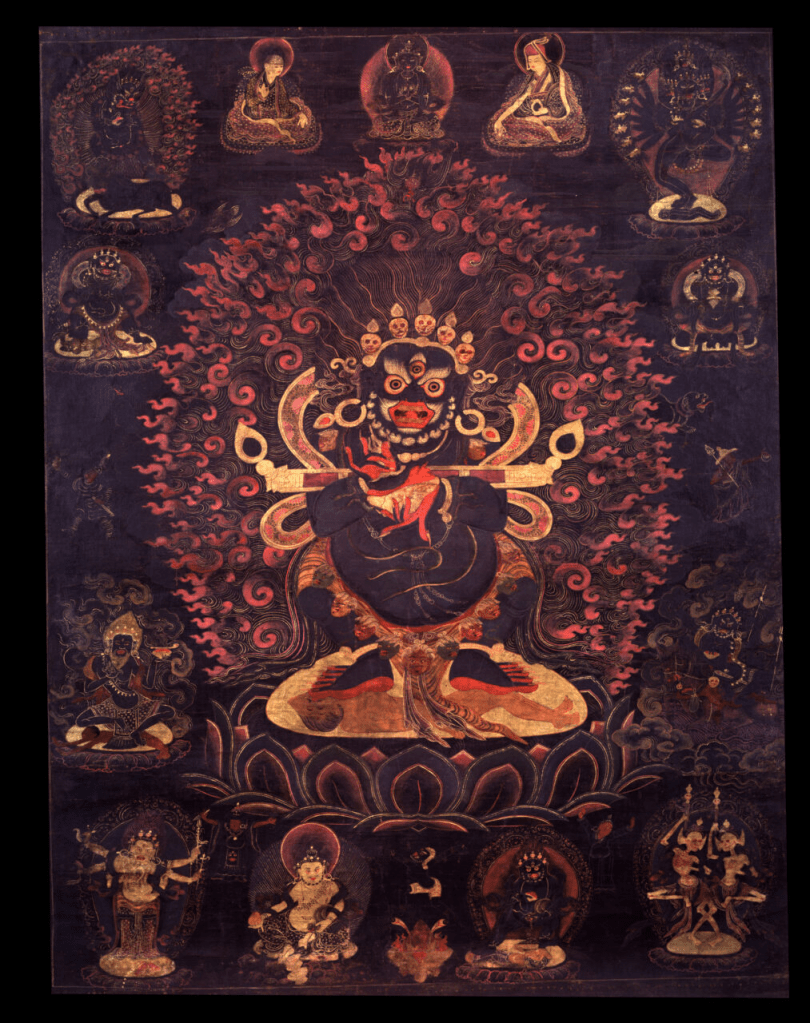
Panjarnatha Mahakala, displayed in the McMullen Museum’s Gateway to Himalayan Art exhibit, embodies many violent iconographic qualities of wrathful Buddhist deities. Indigenous to the Tibetan region, Buddhists widely refer to Panjarnatha Mahakala as an exterminator of black magic and other forms of negative energy. Panjarnatha Mahakala is named after the term “panjara,” which means having one face and two arms, and artists often depict them as very human-like and violent. As a unique protector for the Shri Hevajra cycle of Tantras, Panjarnatha Mahakala has been used as a source of protection by the Mongolians as a war standard during the time of the Yuan Dynasty, alongside many otherworldly applications. Specifically, the Shri Hevajra tantra indicates ultimate reality through imparting wisdom and means to those who follow the ritual tradition.
Highlighted by gold and fiery red pigments, Panjarnatha Mahakala appears to be seated in a royal ease stance, surrounded by a mandala of wild flames. Additionally, Panjarnatha Mahakala has bulging eyes and a toothy grin, a typical characteristic artists often use to depict wrathful deities. Other stylistic attributes include a crown of five dry human skulls, bone and snake adornments, and a ‘Ghandi’ stick held across the body. If you look closely, Panjarnatha Mahakala looks to be sitting on top of a corpse, a symbol of their power. Surrounding the central figure appear to be other wrathful deities, looking down at Panjarnatha Mahakala or towards each other.
Interestingly, Panjarnatha Mahakala’s hands are in the gesture of Tantric unity, an emblem of embrace and consort that symbolizes the unity of wisdom and method. In this sense, it becomes evident that Panjarnatha Mahakala’s wrath comes down to the purpose of guiding and defending their followers. In this sense, it is easy to cast Mahakala as a violent character at first glance. Yet, when exploring the vengeful iconographic elements of Makhala, it becomes apparent that the deity personifies nuanced benevolence. Through adornment with terrifying features, Mahakala can protect people from their worst traits and fears.
Wrathful deities are presentations of the intersection between art and religion and fuse violent characteristics with Tantric manifestations to foster peace and control. Rivaled with classic creatures of Halloween, they are precisely the opposite.

Sources
Geoffrey C. Goble, “Chinese and Tibetan Esoteric Buddhism, ed. by Yael Bentor and Meir Shahar (review)” Journal of Chinese Religions, 46.1 (2018), 71-73.
For the Hevajra Tantra, see http://www.tibetanbuddhistencyclopedia.com/en/index.php?title=Hevajra_Tantra accessed October 29, 2023.