The McMullen Student Ambassadors are pleased to present Art in Focus, featuring an informal discussion between Boston College professors from various academic departments. With each new episode, we aim to uncover a unique perspective on the works on display, informed by research and methodologies in areas of study across the University. Each conversation will bring the exhibition’s works “into focus” to highlight art’s expansive reach and interdisciplinary nature.
For this episode, we invited Professors Sara Ross and Stephanie Leone of Boston College to discuss the exhibition “Medieval | Renaissance: A Dialogue on Early Italian Painting.” Prof. Ross is a history professor whose work focuses on Renaissance Europe, especially Italy, and Prof. Leone is a Renaissance art historian, and a co-curator of the exhibit.
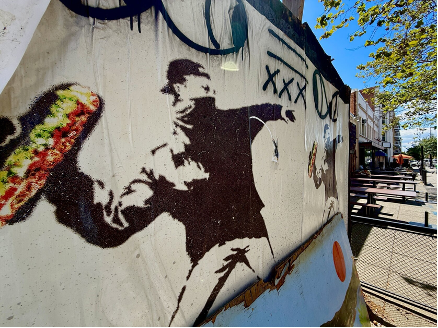
In the summer of 2025, a DC resident and employee for the Department of Justice, Sean Charles Dunn, was celebrated for throwing a hoagie sandwich at a federal police officer during the Trump administration’s occupation of DC city streets. Dunn was arrested and charged with misdemeanor assault, but his image took a life of its own with a series of graffiti art depicting a resistance fighter heaving a hoagie as if it were a molotov cocktail.
The graffiti is printed on cement walls across DC, a symbol of resistance against federal overreach and a response to fears of despotism and martial law. The piece itself seems to be inspired by famous street artist and political activist Banksy who painted a similar depiction of a resistance fighter in Love Is In The Air, where the protester brandishes a bouquet of flowers. Both pieces are statements in support of defiance — not just of any act of rebellion, but rather of strictly non-violent means of defying an unjust government.
To place a sandwich or a bouquet of flowers in the throwing arm of a resistance fighter instead of a molotov cocktail or a gun demonstrates the artist’s preference for nonviolent civil disobedience. Rooted in the principles of Dr. Martin Luther King, Jr. and Mahatma Gandhi, principles philosophized by thinkers like Henry David Thoreau and Hannah Arendt, civil disobedience is the public, non-violent refusal of a government that demonstrators, like Dunn, view as unjust. The value of civil disobedience lies in withholding violence so as not to play into the “myth of redemptive violence,” as theologian Walter Wink coins it.
The myth Wink writes about is that there is justice in committing one act of violence in response to another. Wink argues that violence only perpetuates violence, continuing a cycle of domination — a cycle that created the injustice in the first place. This article comes in the wake of the horrific murders of Charlie Kirk, Melissa and Mark Hortman, the beating of Paul Pelosi, and the arsonist who burned down the home of Governor Josh Shapiro. These crimes come from a passion for a particular point of view, but they are crimes devoid of the compassion we ought to feel towards our neighbors.
Art pieces like Love Is In The Air and the graffiti of DC are testaments to the importance of peaceful discourse and demonstrations in a democratic society. Political violence is corrosive to our democratic institutions and counter-productive for open dialogue—a malignant presence in our current political environment and a threat to our way of life and governance. The artists who advocate non-violence, who push back against this wave of hostility, not only remind us of the virtues of pacifism, but also of the role that art can play in society.
Like the Civil Rights Movement’s freedom songs, murals, and posters or Anti-Apartheid Movement plays like Woza Albert, the “sandwich guy” represents the power that art can have for political representation. Art has the power to influence people, to touch us, to remind us of the higher minded principles foundational to what makes free, fair, pluralistic democratic systems like that of the United States great. An artist’s mission, after all, is to convey a meaning in their work — which is in another sense: a perspective.
Many of today’s trends in music and fashion channel anemoia, or the nostalgia for eras one never lived, as digital communities collectively imagine the 90s through clothing, mood boards, and musical references. Following the 20-30 year trend cycle, the revived interest in the grunge style has been right on time. While contemporary fashion revisits these trends, photography and editorial imagery often do not carry the same raw visual references from the era.
For the past few years, baggy, low-slung jeans, muted colors, boots, and a general favoring of anything thrifted have been mainstays in trend cycles. Following the passing of the influential stylist Melanie Ward, her approach to style — and seemingly to life at large — feels powerful and applicable to today’s fashion landscape.
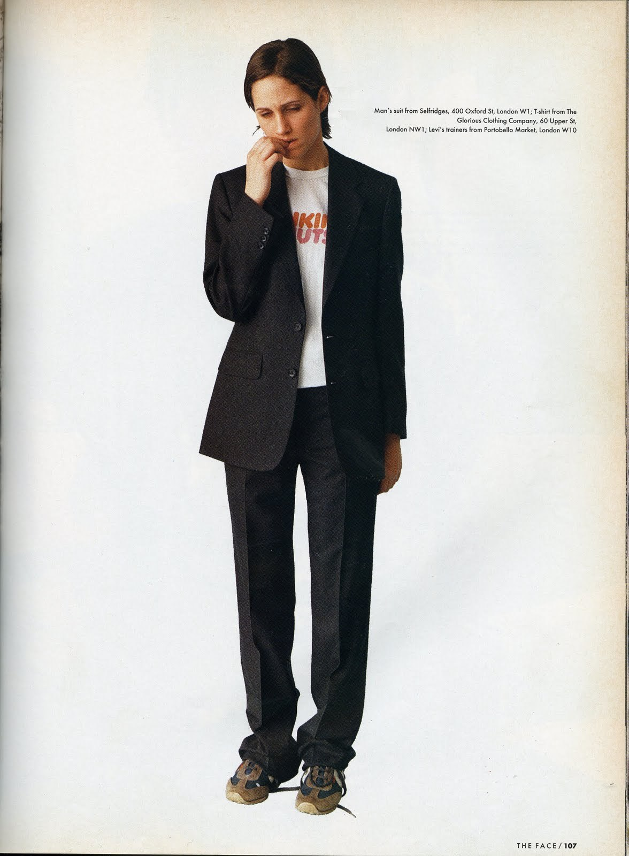
Melanie Ward began her career in the late 80s, incorporating London street and youth culture. Eventually, her styling became a key aspect of defining the grunge style, emerging as a reaction to the polished glamour of the 80s. She emphasized making clothing real and wearable, often blending vintage and contemporary pieces, mixing high- and low-end fashion. Ward’s styles were often captured with a direct flash and a soft blur. She abandoned elaborate sets, carefully designed lighting patterns, or sometimes perfectly metered exposure, in favor of immediacy and intimacy.
There is a presence and dignity in the normalcy of her models’ posing — often informal or awkwardly relaxed. Ward’s styling communicates authenticity in the expression of grounded realness. Throughout interviews spanning the decades, she repeatedly emphasized comfort and the principle that “your clothes don’t wear you.” Her career would eventually lead her to fixed roles at fashion houses such as Helmut Lang, Calvin Klein, Karl Lagerfeld, Louis Vuitton, and Dior. She continued to champion this philosophy at each house, keeping the essence of authenticity with her throughout her career.
While Ward’s realness came from proximity and lived experiences, contemporary fashion photography channels emotional resonance in an opposite way. For instance, Rafael Pavarotti, a friend of Ward, focuses on visual maximalism. Bold color, dramatic lighting, exaggerated and theatrical poses are essential elements of the Pavarotti style. The aesthetic sharply contrasts Ward’s understated approach, but the conceptual goal feels parallel at times.
Pavarotti, who grew up in a small town in the Amazon, moved to London at sixteen to pursue fashion photography. His work demonstrates his capability to shape cultural perspectives on beauty, style, and the human form. His work often highlights Black bodies, addressing disparities in fashion representation and redefining what beauty looks like. Many of his subjects look directly into the lens, creating an intimate connection that invites viewers to engage empathetically with another human presence.
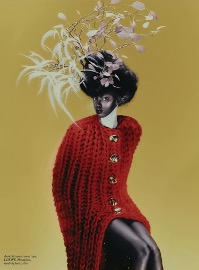
His models are put in positions that make them feel somewhere between powerful, imposing, whimsical, and graceful. The viewer is invited to witness tension and poise in this heightened presence. Each figure is transformed into an expressive subject rather than just a body to hang clothes off of. Pavarotti employs these tactics all to create larger-than-life figures that inspire wonder and leave viewers open-mouthed.
Models Anok Yai and Zaya Guarani in “An Altar to Memory,” photographed by Rafael Pavarotti for British Vogue, March 2024.
While Pavarotti employs bold color, dramatic poses, and exaggerated silhouettes, his work remains sincere and emotionally grounded. He guides the viewer through a heightened, surreal visual experience to center humanity and dignity in every figure. In the drama of his images, the subject remains central, creating a palpable presence that communicates authenticity and emotional resonance.
Today’s fashion trends often intersect with authenticity through digital media. Platforms like Depop, Grailed, and Pinterest curate nostalgia, remix styles, and construct new amalgams of subcultural identities. While many era revival trends are filtered through aestheticized anemoia, rather than lived experience, it continues to reflect the desire for individuality and self-expression. Thrifted and vintage clothing offers a way to signal style and value, echoing Ward’s message of comfort.
Despite their visual differences, both Ward and Pavarotti aim to make their subjects feel present, immediate, and emotionally resonant. The connection doesn’t lie in style or technique, but in the shared pursuit of human dignity. Whether that be through understated honesty in subtlety and intimacy or in boldness in intensity and spectacle, at the center, there is a human commanding your attention. Both remind us to stay captivated by imagined futures, grounded in the authentic present, and reference the past through a collective anemoia.