Categories
Exhibition Spotlight McMullen Musings Problematic Visual Culture

A Portal To Where? 

Lauren Whitlock ‘24 

Drake DiPaolo, a twenty-year-old passionate about museums—and a McMullen Student Ambassador—was ecstatic to see four older people enter the gallery. They appeared frustrated by the video on the far side of the room. In their faces, you could see them asking, “Is this the last one?” as they sat down on the opposite side of the room and began to speak loudly to one another. This room was on the third floor, and on the second was the Barjeel Art Foundation’s show Landscape of Memory, which displayed seven videos focused on the “rich and complex history of the Middle East.” Naturally, the people assumed that this floor would have more of what they had just seen, videos. But this space was a bit different. The room was cramped, with vertical LEDs glaring and dark walls. Exhausted by the exhibit, the viewers discussed how all the videos were about death, and none of them had been in English. Confused, they looked at the people in the video dead in the eye. But, something felt eerie about the figures, as if they were watching the visitors. Drake walked over. 

“It’s actually like a zoom; these people live in a refugee camp.” The visitors spent their remaining time at the museum complaining that they could not hear the people, understand their accents, or even comprehend the point of the exhibit. They made sure to tell me this, the worker at the front desk, on their way out. This uncomfortable scene comes from a semester of bizarre interactions between visitors and “the Portal” at the McMullen Museum of Art from January 30th through June 4th, 2023. 

When I initially heard about the exhibit, the concept of the portal also confused me. I found the name dystopian, fantastical, maybe something out of a Back to the Future Movie. What the hell was the Portal? A Portal to where? Was there more than the video art installations on the second floor? But, on the third floor, there was more: a small room with all-black walls, about 12 chairs, and a video projection. The Portal was unlike a Delorean and had no time or space travel capabilities; its goals were much more advanced. 

I later learned that “The Portal” is not unique.  It is a room-sized audio-visual experience providing a cross-continental connection you can place on any college campus. The proprietor of the technology and licensing, Shared Studios, has a clear Silicon Valley-esque message of connection. Their website displays a picture of President Obama and his words while using this portal: “It’s an amazing technology, making it seem like you are standing right in front of me,” he says while speaking to young entrepreneurs from Iraq. Topics of conversation vary, from climate change to artistic expression, but the overarching theme of cultural exchange is consistent throughout.
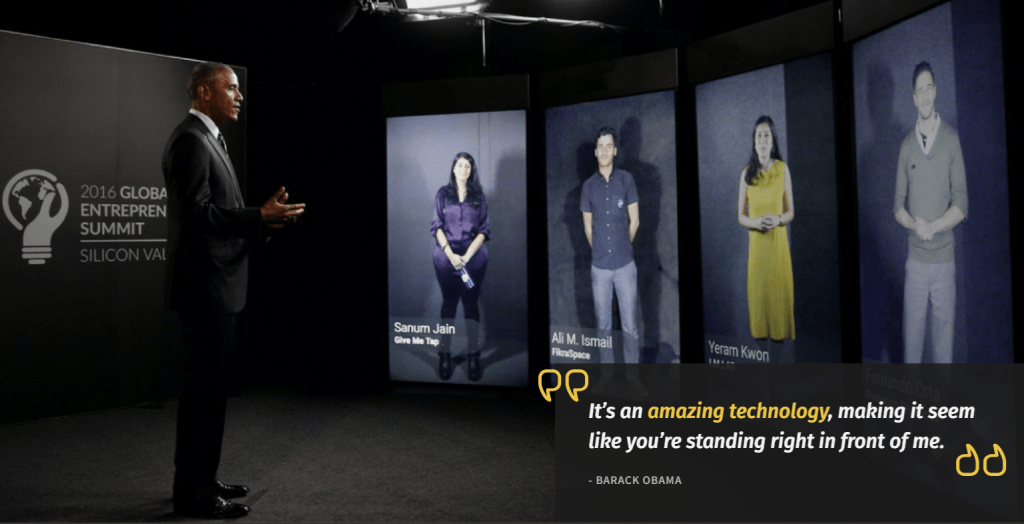
Screenshot from the Shared Studios website.

Now that it was at the museum, patrons and BC students could connect with people from all over the world. Specific topics were encouraged for certain groups. For instance, a group from Barbados talked with a professor and their Oceans class about climate change. A group from the Nakivale refugee group was encouraged by Shared Studios to discuss the portal they built out of bottle bricks. A group from Palestine discussed their futures. Many of them reflected on the current exhibit’s Landscape of Memory’s themes of exile, home, war, and family. The audience was never as diverse as the speakers featured at the Portal. Throngs of white college students entered the museum. They had to write papers on their experience—how were their eyes fully opened? Many of the participants were young college students mandated to be there to meet someone different from themselves. Most would sit there dead silent, hoping to get through the event and get their extra credit. 

In comparison, Drake spent countless hours worried about the Portal and its functions. He would come early to work to set it up, go into every connection with notes on discussion topics, and encourage visitors around the museum to join him. Despite his best attempts, he was the only one willing to put in this effort. Drake recounts moments where he felt like he was pulling teeth; “at times, I felt like I was running a circus. It was hard to manage the people in the room. Sometimes, they would just sit and watch whoever was talking. You had to force interaction.” The placement of the exhibit itself was bizarre. There was a video installation in another part of the exhibit, implying to visitors that this, too, was something to view.  “It was also weird because they are having this interaction, but in the room right next to them is the rest of the exhibit,” Drake said. There was a feeling that museum-goers should view these people, their stories, culture, and even trauma as objects. 

Though conversations that took place in the Portal are essential to understanding one another, to have these conversations within the context of a museum space reinforces power structures. The museum has once again become the playground for people with wealth and power. The people on the other end of the connection are often othered by this experience. Though they are involved in this process, they are the ones on display. The first time I saw the Portal, I was reminded of the historical display of others. I had recently taken a class in Victorian studies and was eerily reminded of their practices. The purpose of the museums in the Victorian period was to display so-called conquered cultures from across the globe. Indian silks and bead-work were an essential feature of the museum. The museum became a part of the nationalistic rhetoric and colonial projects. 
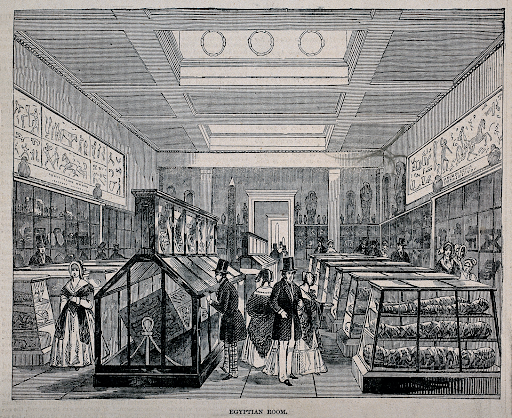
Artist unknown, (1847) The British Museum: the Egyptian Room, with Visitors. 1 print: wood engraving; image 12.2 x 15.4 cm.

The Victorians are also responsible for developing freak shows and human zoos in the late 18th and early 19th centuries to display people with non-Euro-centric features and disabled bodies. Pseudo-science and the academic field of anthropology reinforced these backward forms of entertainment. The basis of science and historical study justified false racialized narratives that pervaded museum exhibitions for the public to view. The “other” was put on display for societal purposes. Museums became a place where the “other” is reminded of their place, and the audience is reminded of their superiority. These interpersonal interactions reflected the colonialist tendencies of Great Britain and other European powers. Viewers mocked, laughed at, and, in some cases, attacked the subjects of the human zoo. 

The Crystal Palace at Sydenham Hill, London. Designed by Sir Joseph Paxton for the Great Exhibition of 1851 and rebuilt in 1852–54 at Sydenham Hill.
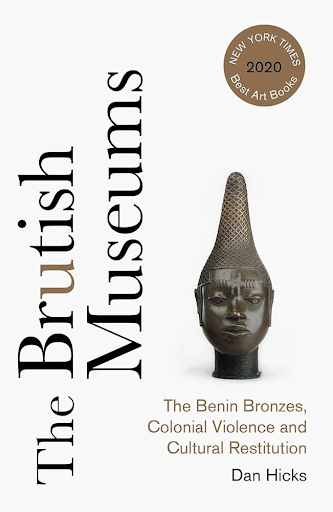
Book cover of Dan Hick’s Brutish Museums: The Benin Bronzes, Colonial Violence and Cultural Restitution.

Dan Hicks, in his book Brutish Museums: The Benin Bronzes, Colonial Violence and Cultural Restitution, describes the “second shot” produced by museums. The “first shot” is the colonial exploitation and theft of indigenous art, and the “second shot” is a continuation of this narrative. Though not entirely the same as a human zoo, the McMullen Museum’s Portal continues the “exhibitory” gaze of the past. Through the Portal, the museum puts the “other” on view. Not only are their bodies on display, but their trauma is now a learning experience for others. The Portal accentuates power differences when watching the conversations, and there is also something Foucauldian about the museum entering these people’s homes. The Portal is an installation meant to connect people, but it has created an exploitative environment in practice. There is constant surveillance of the “other.” Museums have always struggled with this issue. New technology does not break down the old power structures. Exploitation does not need to be at the root of art.

Drake left the interview with a few words, “You can’t view it as an exhibit.” Context is important. In the museum’s attempt to diversify and enrich experiences for their visitors, they exploited the lived experiences of people in countries with fewer opportunities than the US. Yet, exploitation is a conscious choice made by the visitors. A random student who has done nothing to learn about the Portal speakers enters the space differently than someone with the intention of discussing difficult topics. One student, Ashley Shackelton, who participated in a Portal on campus, not in the museum, felt that the experience was necessary to her learning. “It felt like we had to have serious academic conversations if you went with a class. But my favorite most meaningful conversations were about sharing music and books we found inspiration.” We can still meet the goal of the Portal—human conversation—if the person with the power in the transaction is willing to absolve themselves of it. However, Ashley noted that the connection felt blocked by the technology. She notes, “there wasn’t much comfort I could provide… It reminded me that although we could have incredibly enlightening and important conversations, we were still speaking through a video.” 

In attempting to create human interaction, Shared Studios is placing the importance on both groups of people coming together as equals to have a discussion. Reality is not as simple. The conversation is not on an equal playing field in a space of power such as a museum or a college.  Some of my discussions in the Portal were constructive and opened my eyes to new experiences. Drake recalls a moment when the translator had not yet arrived, and a class of students blankly stared at the people on the screen. In a moment of panic, Drake posed the question- Messi or Ronaldo? Everyone in the room understood what was happening and interacted despite the language barrier. Drake is a shining example of how to make this technology work. 

The idea that we are all similar no matter what is true, but understanding differences allows for richer and more empathetic conversations. Historical and present contexts affect these interactions. The only way to move forward is to acknowledge our differences while learning our similarities. In this way, the Portal can work.

Works Cited

Dan, Hicks. The Brutish Museums: The Benin Bronzes, Colonial Violence and Cultural Restitution, Pluto Press, 2020, pp. 152–65. JSTOR, https://doi.org/10.2307/j.ctv18msmcr.17. Accessed 22 Mar. 2024.

Bennett, Tony. The Birth of the Museum: History, Theory, Politics. Routledge, 2005. 

Categories
Problematic Visual Culture

What Artistic Depictions of Thanksgiving Get Wrong

By Liam Conner ’25

National American Indian Heritage Month, since its inception in 1990, celebrates the past and present histories of Indigenous peoples and honors Tribal sovereignty and self-determination. In an attempt to acknowledge the United States’ colonization of formerly Tribal lands, the month recognizes the evils of colonialism and its effects on how we perceive American identity.

Thanksgiving is a holiday that has become a staple for all the wrong reasons. The feast-focused celebration now features early-morning 5Ks, televised parades, football games, and boxed stuffing (albeit the best kind). In classroom retellings of the holiday, we learn that the Puritan Pilgrims peacefully ate alongside their Native American counterparts solely because they developed a friendly relationship. Unfortunately, many accounts fail to mention painful truths, like how the feast coincided with various wars and battles for land. The contextual and historical exclusion of the crucial facts of this story not only allows for these traditions to remain prominent but also disregards the toilsome reality of Thanksgiving and its colonial undertone.

One way to visualize American misconceptions around Thanksgiving lore is to engage critically with depictions of the holiday in art. From Thanksgiving’s earliest representations in the 1800s to the modern clipart we can download on our computers, incorrect retellings inform some of art’s most seminal pieces. 

George Henry Durrie (New Haven, Connecticut, June 6, 1820-1863) Home to Thanksgiving, 1867, hand-colored lithograph, 14 ⅝ X 25 in. co. Mr. and Mrs. Paul Mellon.

One of the first published renderings of Thanksgiving dates to 1867, four years after Abraham Lincoln codified the holiday as a national celebration. In George Henry Durrie’s “Home to Thanksgiving,” a snow-covered farm and its inhabitants greet their guests from the city. Rural tranquility marked with a jovial yet modest celebration demonstrates the escapist nature of the holiday. The idea of leaving a bustling city for the peaceful countryside still prevails today, as relatives convene in a typically calm and welcoming home situated away from the day-to-day. 

While perfectly describing the current nature of Thanksgiving, Durrie’s painting does not reflect its origins in history and conflict. The people in this scene celebrate the holiday that began in 1863, not the 1621 feast that the current holiday attempts to resemble. In no way, however, was the first Thanksgiving utterly peaceful. Instead, the feast most likely celebrated a recent massacre of about seven hundred Pequot Indians or the newly agreed-upon, yet quickly broken, peace treaty between the local Wampanoag Indians and the Pilgrims.1

Jean Leon Gerome Ferris (Philadelphia, Pennsylvania, August 8, 1863-1930) The First Thanksgiving, 1912 Oil on canvas.

Nearly fifty years later, Jean Leon Gerome Ferris’s painting “The First Thanksgiving” attempts to depict the holiday as dominated by the Pilgrims. They are postured above the Native Americans, standing up and feeding them as they sit on the ground. It is as though the Pilgrims were fully responsible for their bountiful harvests and societal advancement, leaving no thanks for the Natives, who were crucial to their survival.

Perhaps the most notable of these native guides is Squanto or Tisquantum.2 Tisquantum, a member of the Patuxet Tribe, was an English-speaking liaison between the Pilgrims in Plymouth and his own Tribe. His story is a prime example of how crucial facts are left out of the general public’s view of the holiday. Many people tend to disregard the question of how Tisquantum learned the culture and language of the English. Many years before, European colonizers captured Tisquantum and sold him into slavery. Because of this enslavement, Tisquantum spent years in England, forced to adapt to the language and ideas of his colonizers.

Norman Rockwell (New York, New York, February 3, 1894-1978) Freedom from Want, 1943. Oil on canvas, 45 3/4″ x 35 1/2″. Norman Rockwell Museum Collections.

A more contemporary look at Thanksgiving includes one of Norman Rockwell’s most famous pieces. “Freedom From Want,” part of a four-part series, displays a family sitting down to eat the Thanksgiving meal. Instead of gawking at the mouth-watering turkey, the family members smile at each other, grateful for their presence. They have no need for a bountiful meal; they just need each other.

Despite the wholesome and anti-materialist representation of this modern feast, the painting still disregards any historical context. The holiday may have signified familial love and gratitude, but that does not mean we should ignore its true and violent origins. Wars across the “new world” surrounded the time of the feast, making it nothing but cheerful. Therefore, depicting the holiday as strictly pleasant is wrong and misleading.

Before the colonization of the “new world,” there were approximately five million American Indians, but by 1800, this population had declined to only 600,000. European colonizers brought disease, quickly killing many Native peoples, yet the wars they waged were the most impactful.3 In a greedy search for land, colonizers decimated Native populations and enslaved the remaining survivors. As a result, Europeans and their colonial desires wiped many tribes completely out, one of them being the Massachusett, who resided on the very land that Boston College now inhabits. Because of this, a month of history is not enough, as many Native Americans call for reparations to begin amending the crimes of the colonizers.4

While these famous works of art certainly depict a widespread misunderstanding of Thanksgiving, there are even false and problematic pieces like these on Boston College’s campus. In Gasson Hall’s rotunda, there are four large paintings on the upper walls created by Francis Schroen, SJ. Two of them display colonizers and their interactions with the local Tribes. 

While attempting to praise these saints, these religious images blatantly show how European colonizers forced Christianity onto the Native Americans. In the first image, it seems as though the holy figure leads the Natives in search of more land. He uses his domineering religion to colonize another land that is not his own. Similarly, the second image depicts a religious ceremony happening right in front of the Natives’ eyes. Placed in the background, they watch from afar, and the painter shows them gazing in a state of awe. The painting inflates the importance of Christianity, deeming it superior to the religion of the Natives. Again, on land that is not their own, the colonizers celebrate divine providence and the false sense of manifest destiny.

It is striking to see these paintings within the halls of Boston College, as they display extremely problematic scenes of colonization. To praise these saints that clearly imposed themselves and their religion on the native population is seemingly against the values of our institution. Unfortunately, this example is not limited to the walls of our own university. Reminders of the incorrect retellings of Thanksgiving and the colonization of the “new world” riddle themselves throughout the United States. Depictions through art are just one of the many ways our modern world ignores the horrific actions of the European colonizers. If we continue to acknowledge these works as accurate, we will never be able to honor the true history of our nation. Instead, we must know that these depictions are wrong and educate ourselves to the greatest extent.

  1. For more of the history of Thanksgiving Day, see https://www.britannica.com/topic/Thanksgiving-Day, accessed 11/27/22. ↩︎
  2. For more on Tisquantum, see https://www.britannica.com/biography/Squanto, accessed 11/27/22. ↩︎
  3. For “The American Genocide of the Indians—Historical Facts and Real Evidence,” see https://www.fmprc.gov.cn/mfa_eng/wjdt_665385/2649_665393/202203/t20220302_10647120.html, accessed 11/27/22. ↩︎
  4. For “‘This is all stolen land’: Native Americans want more than California’s apology,” see https://www.theguardian.com/us-news/2019/jun/20/california-native-americans-governor-apology-reparations, accessed 11/27/22. ↩︎
Categories
Problematic Visual Culture

Problematic Visual Culture: Hair Removal Advertisements & Beauty Standards

By Joy Cheng, class of ‘23

Do you know where our beauty standard of the 21st century comes from and why we shave?  What we find attractive today is rooted in the advertisement boom of the 1950s. Along with the rise of fashion styles like short sleeves and bikinis, companies advertised hair removal products and perpetuated beauty standards of hair removal, especially for women.1 We should, therefore, be wary of the constant exposure and pressure from advertising agencies of profit-hungry companies that harmfully dictate shaving and hair removal trends.

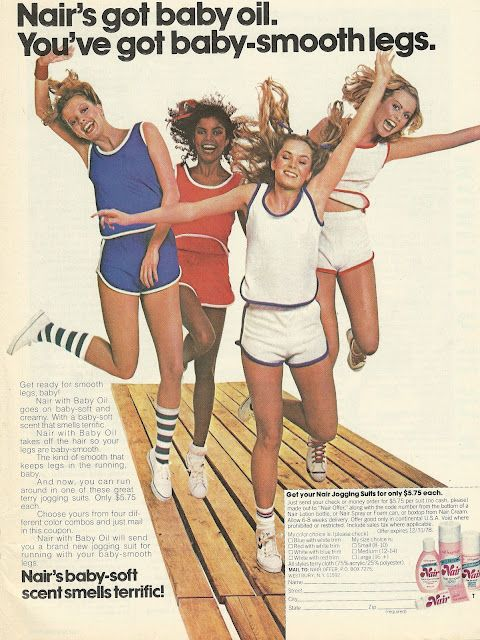
When we think of advertisements, the words “visual culture” are not usually the first thing to pop into our minds. However, advertisements often are forms of visual culture—like paintings, photographs, or videos and it is through these mediums that advertisers can associate beauty and happiness with hair removal. When we see ads like the one below, we often compare ourselves with these models—desiring to be happy, proud, and feeling good about our bodies. We draw an interesting connection between being beautiful and shaving; “if I want to be just like that model, I should shave my body hair too!” As a result, we come to the conclusion that “if I want to shave my body hair, I’ll need to buy a razor.” In other words, advertisements are a form of visual culture that attempts to influence consumers’ actions in a way that leads them to purchase products. As a result, corporations promote hair removal, making products like razors a necessity to gain profits.

Pictured above is a 1978 magazine ad for the hair removal product Nair.

In the modern digital age, we are more exposed to advertising than ever before. Advertising is omnipresent, from billboards on the highway to Instagram ads to full-page spreads in newspapers and magazines. Sometimes advertisements are not evident at first glance—a shelf of sleek Gillette razors at CVS is a form of advertising too. With ‘winner of Allure’ or ‘best of 2021’ signs, our eyes are bound to pay attention to these catchphrases. Yet, most of the time, we do not realize how they influence our thoughts. With so much exposure to advertising, it is no wonder that we begin to internalize the messages they present. As we internalize messages about hair removal, we may perceive ourselves as ugly for having body hair—even though body hair is perfectly normal! The goal of advertising is to sell products and capitalize on both real and manufactured insecurities. By perpetuating beauty standards of hair removal, advertisers influence women’s self-perception in unhealthy ways by telling people that they need to shave in order to be beautiful.

Advertising taglines reveal explicit attempts to create beauty standards for hair removal. For example, one ad from the 1900s asks us, “are you going to permit unsightly hair on your face, arms, underarms, and limbs to spoil the freedom which awaits you at the beach?” while another reads, “summer dress and modern dancing combine to make necessary the removal of objectionable hair.”2 These ads are trying to generate shame about our body hair—it is something shameful that spoils our fun and how others perceive us. We see similar ideas in modern-day ads, like a Gillette Venus advertisement that states, “you’re a woman, shave like one,” implying that shaving is necessary for women.3 The message is consistent throughout decades—we need to eliminate body hair because it impedes us from being viewed as beautiful.

Gillette’s advertisement for Venus Embrace Razor in 2012.

Today, people are challenging the notion that we need to shave to be beautiful. Body hair is becoming more and more accepted as beautiful, and we see that some celebrities are confronting conventional beauty norms that mainstream culture imposes onto us. Julia Michaels, a singer, announced on Twitter that she is “not shaving [her] armpits ever again… social norms can eat an eggplant.”4Mo’Nique, a comedian, says, “I tried shaving one time, and it was uncomfortable and painful… I said never again would I do that to myself.”5 Beyond celebrities, we see public opinions moving towards body hair acceptance through movements like #Januhairy, a social media campaign encouraging women to grow their body hair for the month of January.

Left: Pictured above Mo’Nique showing off her unshaven legs at the Golden Globes in 2017. Photo courtesy of Getty Images. Right: Instagram account showing support for #Januhairy movement.

Beyond celebrities and popular sentiment, there are also emerging shaving companies that promote body hair acceptance. One such company is Billie, a razor company, which states that “what you do with [your hair] is up to you – grow it, get rid of it, or comb it.”6 Another company, Estrid, is running a “Super Hairoes” campaign to help women feel more comfortable about their body hair.7Although we could be cynical about the whole thing and claim that these companies are just trying to profit from public sentiment, it does do its part in bringing us to question certain status quos and their origins. Even though they sell hair removal products, they are not trying to generate insecurity about body hair and profit from it. Rather, they are trying to support consumers with their own choices about body hair. I think this is what we need—advertising that supports our body hair choices rather than enforcing uncomfortable beauty standards.