


By: Chase Gibson ’26
In a 6.5-acre stretch of cityscape in Chicago, Illinois, there’s a neighborhood colloquially known as “Boystown.” Chicago has a repressive and violent history with the LGBTQIA+ community—routine police raids on gay bars, harassment against same-sex couples, and public exposure in local newspapers. And yet, if you were to walk the streets of Boystown, you could catch yourself forgetting this history as you use rainbow-clad crosswalks, gaze at murals celebrating gay icons, and shop at boutiques bursting with pride. At least in this part of town, the queer community is visible, proud, and directly in your face.
The neighborhood represents a deliberate effort to reshape how sexuality and gender identity appear in public space. For those who call Boystown home, simple acknowledgment of non-heteronormative identities is not sufficient. The area functions as a refuge for people who, for generations, were forced into silence or hidden away in what is commonly described as “the closet.” In response to that history, residents and community organizers have worked intentionally to ensure that the neighborhood visibly and unapologetically affirms queer identity. Through public art, symbols of pride, and community events, Boystown asserts itself as a space where queer presence is not subtle or implied but openly and unmistakably claimed.
The visual language of Boystown also belongs to a longer artistic tradition in which queer artists used imagery to challenge social boundaries. One notable example is Francis Bacon’s painting Two Figures, which depicts two nude men entangled on a bed. Created in the early 1950s, when homosexuality was widely stigmatized and often criminalized, the work carried a quiet but unmistakable defiance. Bacon himself experienced rejection for his sexuality and gender expression, having been cast out of his family home as a young man. In that context, the painting becomes more than a private scene; it is an assertion that intimacy and identity exist beyond the narrow expectations imposed by society. By presenting queer intimacy openly on canvas, Bacon helped push representation out of secrecy and into visibility. In many ways, the visual landscape of Boystown continues this same tradition, translating the once-radical act of depicting queer life into murals, symbols, and public spaces that openly affirm it.
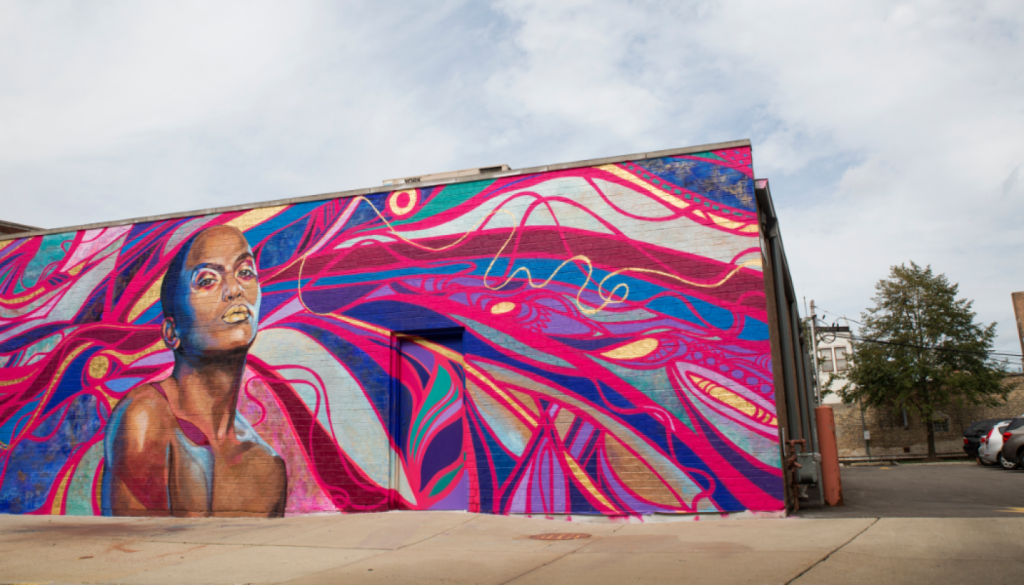
In 2018, Chicago’s Department of Cultural Affairs unveiled a self-portrait mural of queer interdisciplinary artist Kiam Marcelo Junio. The purpose of the mural is to open dialogue about intersecting identities as well as represent non-binary people. However, at the most fundamental level, the mural is a representation of the multiplicity of the human experience.
Public art such as this mural does more than decorate the neighborhood. It transforms the physical landscape into a kind of cultural archive, preserving the stories of people whose identities have often been erased or ignored. Boystown transforms into an open-air gallery where people constantly reimagine sexuality, gender, and belonging. Each mural, sculpture, and symbol contributes to a collective narrative that insists queer lives are not marginal but central to the fabric of the city. In this sense, Boystown is not simply a place of celebration. It is also a declaration of presence, a reminder that visibility itself can be a powerful form of resistance against the long history of silence imposed on LGBTQIA+ communities.