
By: Chase Gibson
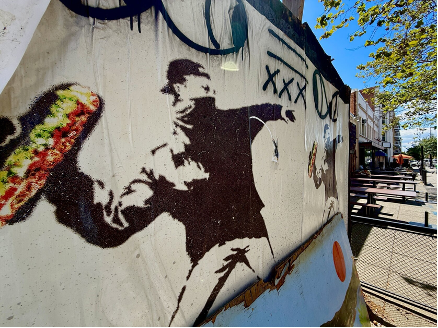
In the summer of 2025, a DC resident and employee for the Department of Justice, Sean Charles Dunn, was celebrated for throwing a hoagie sandwich at a federal police officer during the Trump administration’s occupation of DC city streets. Dunn was arrested and charged with misdemeanor assault, but his image took a life of its own with a series of graffiti art depicting a resistance fighter heaving a hoagie as if it were a molotov cocktail.
The graffiti is printed on cement walls across DC, a symbol of resistance against federal overreach and a response to fears of despotism and martial law. The piece itself seems to be inspired by famous street artist and political activist Banksy who painted a similar depiction of a resistance fighter in Love Is In The Air, where the protester brandishes a bouquet of flowers. Both pieces are statements in support of defiance — not just of any act of rebellion, but rather of strictly non-violent means of defying an unjust government.
To place a sandwich or a bouquet of flowers in the throwing arm of a resistance fighter instead of a molotov cocktail or a gun demonstrates the artist’s preference for nonviolent civil disobedience. Rooted in the principles of Dr. Martin Luther King, Jr. and Mahatma Gandhi, principles philosophized by thinkers like Henry David Thoreau and Hannah Arendt, civil disobedience is the public, non-violent refusal of a government that demonstrators, like Dunn, view as unjust. The value of civil disobedience lies in withholding violence so as not to play into the “myth of redemptive violence,” as theologian Walter Wink coins it.
The myth Wink writes about is that there is justice in committing one act of violence in response to another. Wink argues that violence only perpetuates violence, continuing a cycle of domination — a cycle that created the injustice in the first place. This article comes in the wake of the horrific murders of Charlie Kirk, Melissa and Mark Hortman, the beating of Paul Pelosi, and the arsonist who burned down the home of Governor Josh Shapiro. These crimes come from a passion for a particular point of view, but they are crimes devoid of the compassion we ought to feel towards our neighbors.
Art pieces like Love Is In The Air and the graffiti of DC are testaments to the importance of peaceful discourse and demonstrations in a democratic society. Political violence is corrosive to our democratic institutions and counter-productive for open dialogue—a malignant presence in our current political environment and a threat to our way of life and governance. The artists who advocate non-violence, who push back against this wave of hostility, not only remind us of the virtues of pacifism, but also of the role that art can play in society.
Like the Civil Rights Movement’s freedom songs, murals, and posters or Anti-Apartheid Movement plays like Woza Albert, the “sandwich guy” represents the power that art can have for political representation. Art has the power to influence people, to touch us, to remind us of the higher minded principles foundational to what makes free, fair, pluralistic democratic systems like that of the United States great. An artist’s mission, after all, is to convey a meaning in their work — which is in another sense: a perspective.