

By Emily Barnabas ’26
Opening on January 29, 2024, Boston College’s McMullen Museum of Art will host “The Lost Generation: Women Ceramicists and the Cuban Avant-Garde,” an exhibition showcasing the artistic products of the Taller de Santiago de las Vegas. Produced amidst the Cuban Revolution (1949-59) in a ceramic workshop on the outskirts of Havana, over one hundred vases, mugs, water jugs, murals, and plates will be on display for visitors. While these objects are remarkable as beautiful pieces of artwork, their significance to the exploration of gender, psychology, social status, and cultural attainment in Cuban society is equally fascinating.1 We can track this artistic movement back to Juan Miguel Rodriguez de la Cruz, the owner of the premier Taller de Santiago de Las Vegas, and he was known for employing little-known female ceramicists. In Spanish, “taller” refers to an art studio or workshop.
To better appreciate the importance of “The Lost Generation: Women Ceramicists and the Cuban Avant-Garde,” let us take a look at some of the women who made reverberations in two main ways: first, for the acceptance of ceramics as a Cuban fine art form and second, for the acknowledgment of women in the arts.

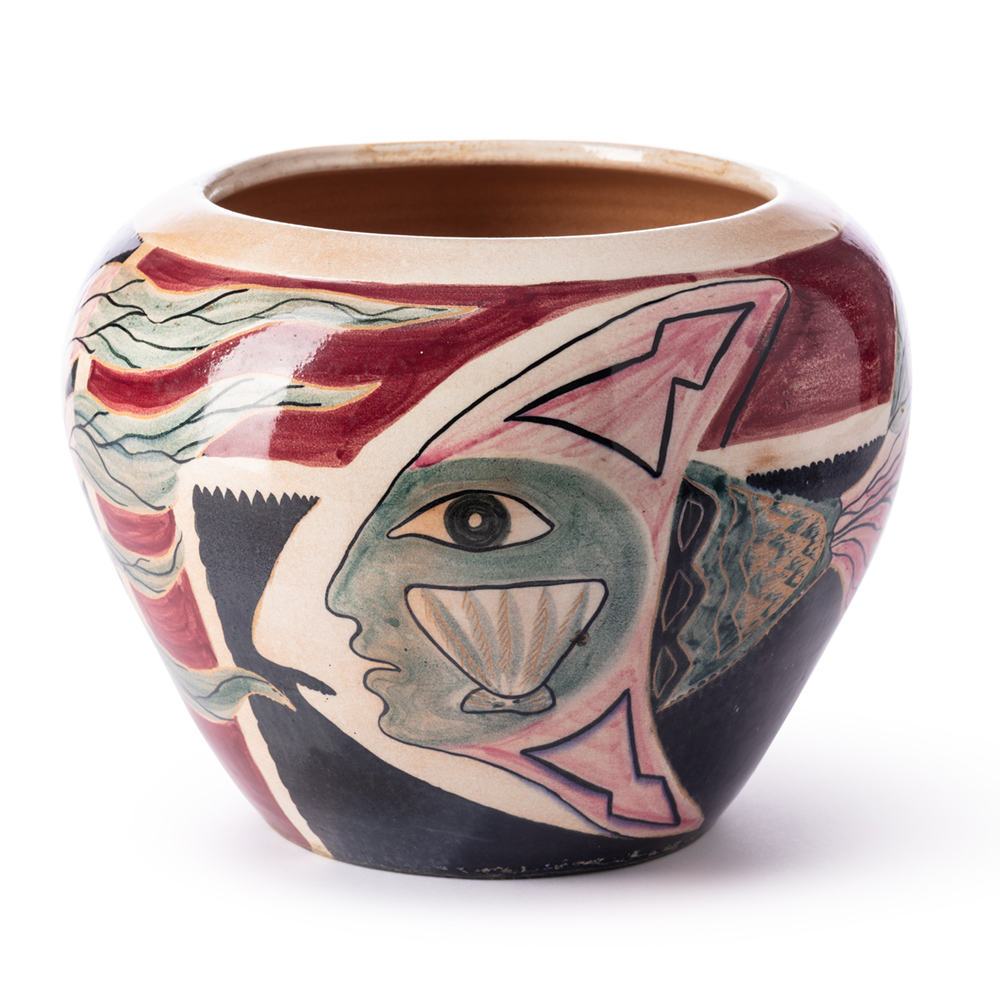
Mirta Garcia Buch (1919-96) (pictured above; second from right) pioneered artistic ceramics in Cuba. She is best known for her murals of ceramic fragments displayed at Hotel El Bosque and Hotel La Sirena in Varadero, which she completed in 1995. In the McMullen exhibition, visitors can observe Buch’s craft in the work Flower Pot with Fish-Man, a painted ceramic from 1953. Other notable achievements of Buch include her work as a technical draftsman at the National Institute of Agrarian Reform and as a technical lithography draftsman at the National Bank of Cuba.2 A selection of her works are part of a permanent exhibition at the Palace of Fine Arts of the National Institute of Culture in Havana.
Amelia Pelaez (1896-1968) (pictured above; center) used cubist and European modernist styles in her ceramics. Unlike other female ceramicists in the exhibition, Pelaez had extensive art training. As a student, she moved to Paris on a grant from the Cuban government to study art solely.3 She seized this opportunity by taking Nationale Superieure des Beaux-Arts and Ecole du Louvre classes. The eleventh Salon de Tuileries featured Pelaez as a testament to her studies. After returning to Cuba, Pelaez worked in a solo exhibition at a women’s art club in Havana, known as the Lyceum; this female-centered art space helped Pelaez achieve her renowned modernist Cuban style. Beyond ceramics, Pelaez was interested in paintings, drawings, and murals. Her fervent passion for the arts led her to accomplish acclaimed murals at the Habana Hilton Hotel and Tribal de Cuentas in Havana. After she died in 1968, the Museum of Modern Art in New York City acquired many of Pelaez’s pieces. Today, we remember Pelaez as a trailblazer in Cuban art and one of the first to introduce artistic symbolism into ceramics.4 You can view Pelaez’s artistry in this spring’s (2024) exhibition by seeing the piece Ceramic tiles for Salesian Rose Perez Velasco House Mural, a series of painted ceramic tiles from 1956.

Most of the remaining information on Elia Rosa Fernandez de Media‘s life and artistic work is from the University of Miami’s Elia Rosa F. Mendia Collection.5 The collection holds personal papers, photos, and media correspondence for research purposes. One of the more interesting materials in the collection is a booklet from the Cuban Museum of Art and Culture’s exhibit on Cuban women. As a lesser-known Cuban artist, we celebrate Mendia today for her Nordic-inspired and austere ceramics.6 In collaboration with artists like Marta Arjona and Amelia Pelaez, Mendia developed her craft by creating art in her own Taller de Vedado.
The work pictured below exemplifies the collaboration between female artists during the “golden age” of Cuban ceramics. The painted ceramic plate, Collective Plate with Fish Motifs, is a product of Rosa Jimenez, Aleida Gonzalez, Maria Elena Jubrias, Mirta Garcia Buch, and Elia Rosa Fernandez de Mendia. As represented in the piece, the camaraderie between Cuban female artists produced a period of power in Cuban art history. With their various styles blending, it is clear that they created their very own ceramic aesthetic together, and we should forever remember the legacy of Cuban female artists.

- For Cuban Modern Art, see https://moderncubanart.com/Cuban-Art-and-National-Identity accessed 12/09/23. ↩︎
- For Mirta García Buch: Synthesis of her life and artistic career, see https://cmlezama.blogspot.com/2020/04/mirta-garcia-buch-sintesis-de-su.html accessed 12/09/23. ↩︎
- For Amelia Peláez, see https://en.wikipedia.org/wiki/Amelia_Pel%C3%A1ez accessed 12/09/23. ↩︎
- For Amelia Pelaez (Cuban 1896-1968), see https://www.christies.com/en/lot/lot-4804057 accessed 12/09/23. ↩︎
- For the University of Miami’s Elia Rosa F. Mendia Collection, see https://atom.library.miami.edu/chc5189 accessed 12/09/23. ↩︎
- Manuel Fernández Velázquez, “Approach to the Emergence of Artistic Ceramics in Cuba,” see http://portal.amelica.org/ameli/journal/784/7843888003/7843888003.pdf accessed 12/09/23. ↩︎